Covid-19 continues to attack us from all angles. For the first time since it began, Carnival went ahead without its street party. Instead, this year, the trail of steel pans, hypnotic percussion and circuit of sound systems was moved into the virtual space. It’s not just the music-filled streets of Notting Hill or the unity of a community, or even the spectacle and sparkle of the costumes and floats that we missed, but the food too. No jerk chicken this year!
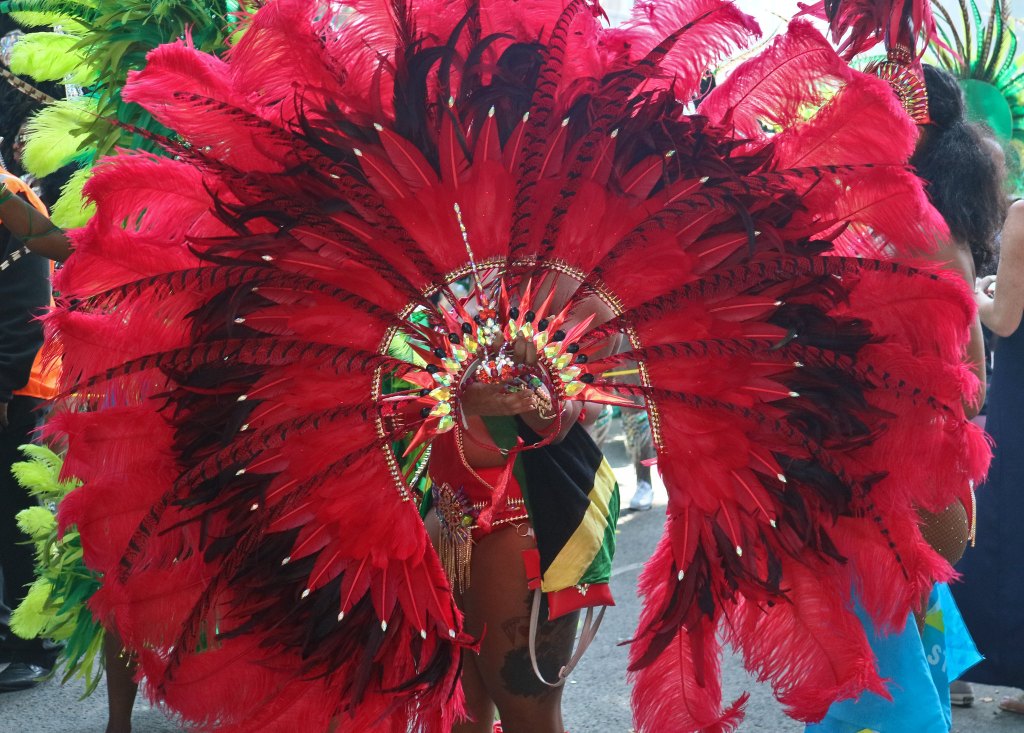
In truth, it’s probably not the first year that there hasn’t been smoking jerk barrel drums, neither is it the first time that Carnival has taken place off the streets. The first Carnival, back in 1959, took place indoors at St Pancras Town Hall, and in January, the peak of winter. Back then, tropical ingredients like allspice berries needed for jerk seasoning were hard to come by. It was also near impossible to buy ingredients for Caribbean specialities like Jamaica’s Akee and Saltfish (salted codfish cooked with indigenous ackee fruit) and Pepperpot (traditional Amerindian-derived dish from Guyana). Even so, Caribbean food was served at the event, dishes like chicken curry, roti, rice and peas and souse (spiced and pickled pig meat) made a show, reminding people of home.

The carnival had been organised ‘to raise spirits to demonstrate resilience and celebrate Caribbean culture’ at a time when race attacks had sparked a wave of riots around Britain, including around Notting Hill, the year before. In response to the damaging effects the conflict was having on the black community, Trinidadian-born woman, journalist and communist party activist, Claudia Jones, organised the indoor carnival. She wanted to do something that would celebrate West Indian culture and lift people’s spirits.
The year before, Jones had founded Britain’s first black newspaper, The West Indian Gazette. The Gazette had strong ideological commitments, and it connected the issues West Indian immigrants were confronting in Britain to the global struggles against colonialism and racism. It provided a space for writers to publish accessible commentary on their experiences and race relations in Britain, African independence movements, and on the US Civil Rights Movement. Jones wanted the newspaper to nurture a sense of cultural consciousness among West Indians, through its writers.
During the fifties, West Indian immigrants came to Britain at a time when the racist rhetoric of Oswald Mosely, British fascist politician was intensely popular. He appealed to a poverty-stricken white working class who bought into the idea of blaming migrants for their economic and social hardships. Unrelenting race attacks across Britain had spurred Jones to put on a soul-building event that would serve to bolster a black working-class battling with unemployment, low wages and discrimination at every turn.
The event was immensely popular and attracted the support of activists, artists and writers. Among the artists present were Boscoe Holder, Fitzroy Coleman, Mighty Terror and Edric Connor. Jones was applauded for organising what at first seemed unfeasible, an indoor carnival. Her energy and instinct for timing was one of her many gifts. At the time, the Carnival stage manager, political activist and socialist, Trinidadian Trevor Carter, said “Claudia, unlike the rest of us, understood the power of culture as a tool of political resistance. The spirit of the carnival came out of her political knowledge of what to touch at a particular time when we were scared, in disarray.”
The following year, Carnival was held in a larger venue, the Seymour Hall, Marble Arch. It headlined with calypso genius, Lord Kitchener and actor, Cy Grant. Writers Samuel Selvon (The Lonely Londoners (1956)) and George Lamming (The Emigrants (1954)) were on the panel for the beauty queen pageant. And the event’s popularity grew in the two years that followed, moving each time to larger venues: Porchester Hall and then the Lyceum Ballroom.
It wasn’t until 1964 that Carnival moved to the August Bank Holiday and onto the streets. Although, Jones was not involved in organising it, the event followed through her ambitions to bring together community through its culture. The street party came about because Ladbroke Grove social worker and community activist, Rhaune Laslett, wanted to organise outdoor festivities for local children from various ethnic groups. She was of mixed Native American and Russian descent, and, she too had wanted to lift the children’s spirits.
Musician extraordinaire, Russell Henderson, worked alongside Laslett, and was pivotal in setting up what was to become Notting Hill’s first Carnival. They enlisted musicians and children’s performers to attend what was described as a ‘street party’. Laslett wanted “to prove that from our ghetto there was a wealth of culture waiting to express itself, that we weren’t rubbish people”.
The local council had granted Laslett permission for an outdoor party to take place and had agreed to cordon off part of Portobello Road. Once the festivities kicked off, with music from the Russell Henderson Steel Band and performances from kids entertainers, it took on its own momentum. Taking off down Ladbroke Grove, it grew fast as local West Indians joined in with the music and dancing. White British onlookers were also drawn into the parade.
From children’s street party it turned quickly into a parade. The ‘carnival’ partied on down past Holland Park and beyond the cordoned area, managing a much bigger circuit than agreed with the council. Since Jones and Laslett’s successes, the Notting Hill Carnival has taken place every year, continuing to be a space where the black community come together to perform, party, eat and defend their civil rights. Although, the Carnivals that followed those early years were not without obstacles.
The sixties brought its own challenges, not least with the Enoch Powell River of Blood speech on 20 April 1968. If anything was going to consolidate a civil rights movement in Britain, it was a venomous populist orator like Powell. He fed the insecurities of the white British unemployed and working class with his anti-migrant and nationalist speeches, not dissimilar to some of the commentary heard around Brexit today.
By the seventies and beyond, Carnival increasingly became a meeting point of police brutality and the disillusionment of young black and Asian people. Britain was blatantly failing its second generation West Indians, with many feeling alienated by British institutions and subjected to high unemployment rates. The Met Police constructed a stereotype of young black men as criminals, using and abusing stop and search laws to harass and provoke. Police and Thieves by Jnr Murvin and Lee Scratch Perry become a symbol of that conflict and an anthem at Carnival.
My own first experience of carnival as a child was of a lively musical colourful moving show, jaw-stopping costumes and a deep bass that reverberated through my roasted sweetcorn. Add to that memory, mixed feelings of fun and fear; and breaking into a sprint when the police charged the crowd, and my parents holding on tightly to my hand as we ran, until we reached a safe corner.
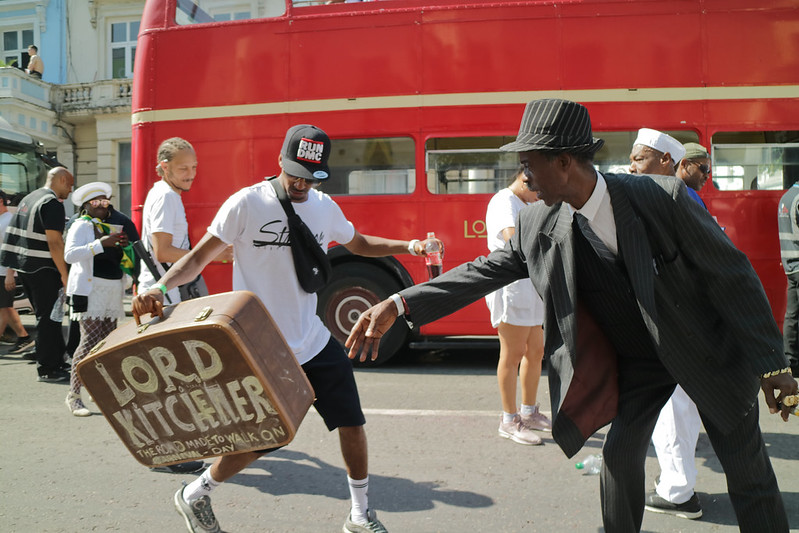
Over the years, carnival has grown from its black community base, galvanised first by Claudia Jones and later by Rhuane Laslett, into the largest street festival in Europe. Without the musical thread of calypso, reggae, dance hall, soca, chutney, dub and ska giving expression to a growing black political consciousness, British culture would look very different today. For me, Carnival’s music expressed the West Indian experience in Britain and unified the voice of protest. Without it, we couldn’t have had the political expression or call for black and white to unite against racism in the lyrics of two-tone, jungle, hip hop, garage, grime, rap and more.
This year, had Carnival gone ahead on the streets, the same defiant confrontation of oppression that Jones had pioneered through her writing, activism and support, would have been headlining in lights on centre stage. From Carnival’s civil rights and community activist roots, we have a strong and important tradition that continues to be relevant and significant. The Black Lives Matter movement would have been visible and present in the people, music and parade, loud and proud.
Despite the absence of the street carnival, there were socially-distanced, mask-wearing demonstrators marching in Notting Hill last Sunday in the Million People March. They were demanding respect, justice and dignity. They were mourning too, the human loss, caused by a global system that fails the black community and asylum seekers and refugees. From the streets around Portobello, the demonstrators’ aim was to bring together all the different communities calling for change, just like carnival’s foremothers had, the women who started it all.
..
Wonderful World, Beautiful People – Jimmy Cliff – Released 1969
Take a look, at the world
And the state that it’s in today
I am sure, you’ll agree
We all could make it a better way
With our love put together
Everybody learn to love each other
Instead of fussing and fighting
Cheating, backbiting
Scandalizing and hating
Baby, we could have a
Wonderful world, beautiful people
You and your girl things could be pretty
But underneath this, there is a secret
That nobody can reveal
..
Rest in Power, George Floyd
Rest in Peace, Mercy Beguma
Rest in Peace, Chadwick Boseman, King
..
..
Carnival feeds thousands of people each year as they party through the bank holiday weekend. It’s brought the food of the West Indies to the streets of London. Jerk pits park up on road corners and stalls set up selling Trini rotis and Guyanese Pepperpot on Notting Hill’s gentrified streets. If you missed your fix of Jamaican jerk chicken this year, I’ve included a recipe for fans. To keep it real, make sure you get hold of its characteristic blazing scotch bonnets. The flavour is only matched, (or surpassed even?), by the Guyanese wiri wiri pepper.

Scotch bonnet peppers 
Jerk seasoning
Jerk cooking is a testimony to slave rebellions and unity on the island of Jamaica. The indigenous Tainos, living on the island before European colonisers arrived, were long using a type of smoking and barbecuing to cook meats. Later, freed slaves, formerly from African nations, formed a rebellious community, the Maroons, that united with the Tainos against the British and their enslavement and exploitation. Once the British formally accepted defeat, the Maroons settled, and ‘jerk’ cooking developed into a style of cooking that focussed more on flavour and less on food-on-the-go. Using Taino methods, meat was cooked with smoke and heat, and allspice tree branches to fuel the fire. Local hot peppers were later added to create a seasoning resembling the smokey and spicy jerk seasoning we know today.
Jerk Chicken

Jerk Seasoning:
25g/¼ cup dried allspice berries (also known as pimento)
1 inch cinnamon stick
1 teaspoon freshly grated nutmeg
½ teaspoon freshly ground black pepper
1 teaspoon dark brown sugar
6 spring onions (green onions) including green parts, roughly chopped
6-8 large celery leaves (optional)
1 large sprig of fresh thyme, use only the leaves
2/4 cloves of garlic, peeled and crushed
1 small onion, peeled and quartered
3 scotch-bonnets, seeded and halved
juice of ½ lime
salt to taste
around 1kg chicken pieces
2 tablespoons vegetable oil
Traditional mortar and pestle method: You can make the entire jerk seasoning in a large mortar and pestle, instead of using a spice blender and food processor.
- Pre-heat oven 350oF. Place allspice berries in a non-metal ovenproof dish and roast in the oven for 5 minutes. Remove and allow to cool.
- In a spice blender, or mortar and pestle, grind the allspice berries, cinnamon and black peppercorns until ground. Add the grated nutmeg to the spice blend.
- Place the spring onions, onion, garlic, scotch bonnets, celery leaves, thyme leaves only, sugar and lime juice into a mini food processor and blend until all the ingredients are minced. Transfer to a small bowl and add the ground spices. Season with salt.
- With a sharp knife, pierce the chicken pieces several times.
- Add the jerk seasoning to the chicken and mix well. Leave covered and refrigerated to marinate for around 3-4 hours, or overnight if time allows.
- Cooking:
In the oven: Pre-heat oven to Gas 6/200oC/400oF. Put the oil in a roasting dish and spoon half of the marinade on top. Bake in the middle of the oven for 20 minutes. Reduce temperature to Gas 3/170oC/325oF and cook the chicken for around 45 mins -1 hour. During cooking, baste the chicken pieces with the pan juices.
On the bbq: Prepare the bbq to a high temperature (around 400oF) and first seal the meat pieces on both sides. (This can be done directly above the coals.) Ideally, a covered bbq is best, or you can cover an open bbq loosely with aluminium foil. Then, put the lid down (or cover with foil) on a drum or kettle bbq with vents slightly open, and reduce heat to low (325oF) with the lid down for around 1 hour or until chicken is cooked through. Or use indirect heat, by pushing coals to the side. This will prevent flare ups. - Traditionally served with rice and peas or good on its own with an iced cold beer.
Serves 4
Bibliography:
Sounds Like London, Lloyd Bradley, Serpent’s Tail, 2013
History Today, Jerk an Authentic Taste of Jamaican Liberty, Alexander Lee, Volume 69, 5 May 2019
 Pamela Lalbachan