Lakshmi travels well

Indian Sweets By Adam Aitken, poet, writer and food photographer, Australia

Certain emotions bridge the years and link unlikely places.” V S Naipaul, Trinidadian writer


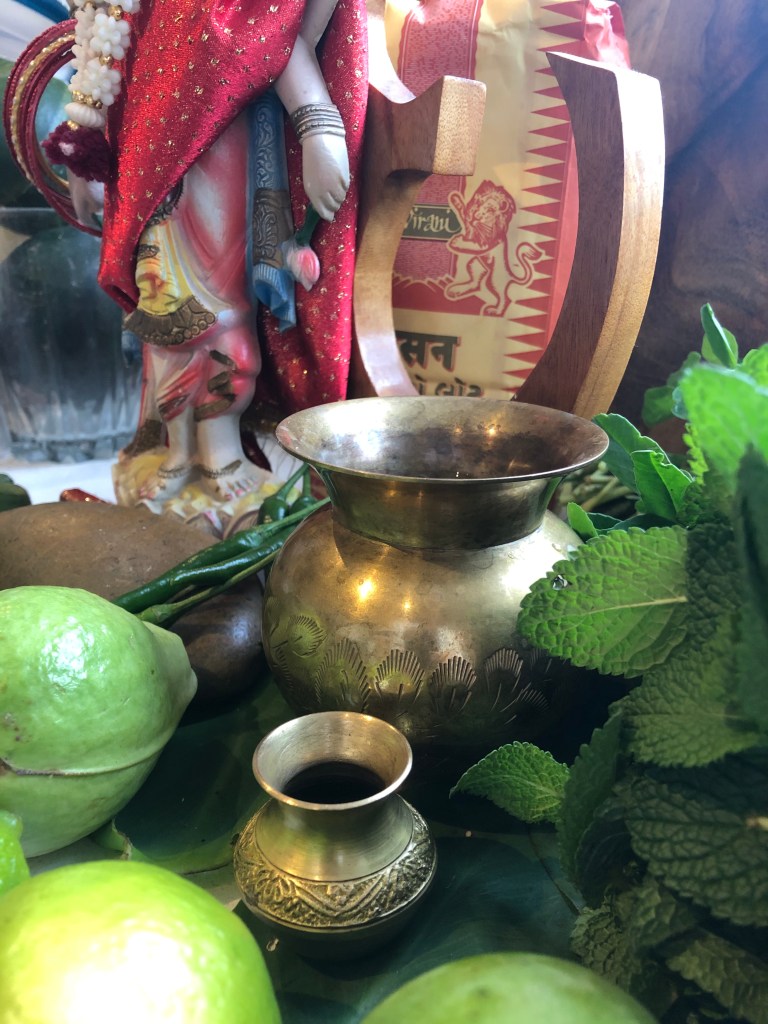
I started writing this blog, inspired by Diwali and the food and warm feeling I associate with it. Although it is a Hindu Festival, it is not the religious aspect in particular that I feel connected to, rather it is a sense of heritage and identity that move me. Lakshmi, who is honoured by Diwali, sat among the revered murtis (statue of a deity) in my Grandma’s living room, and together, the two of them made Diwali a lasting family tradition. They created a sense of belonging and hope when Diwali-time came around, which I have kept and carry with me. 

According to the Times of India, Indians make up the largest population living outside their country of birth. It‘s no surprise when you look at the back story that there are now around 18 million migrants living abroad. The expansion of the British Empire, as well as that of its European imperialist cousins’, resulted in the making of one of the world’s significant Diasporas.  Together, and often in agreement, they transported thousands of Indian labourers to the Caribbean, Africa and parts of the South Pacific and South Asia from 1830s to 1920s. It is through these ancestors that Indian religions, customs and beliefs have sustained, and sometimes, evolved outside of India. 

The popularisation of many religious events and festivals around the world, has put Diwali, among other celebrations, on the international calendar. Around this time of year, Indian recipes and ingredients appear in the supermarkets’ glossy magazine specials and television food shows are brimming with Indian cooking content. Long-time chef, Mary Berry, widely renowned for her British baking and cooking, recently departed from her regular format to visit a London-based family celebrating Diwali in her current television series. 

In spite of an increased market culture of commercialisation and promotion, it is the Disapora’s deep rooted affinity with Mother India that its descendants have honoured and conserved. Through the generations, the Diaspora has cultivated an unbreakable sense of self which I see in Indian families and communities. I learnt of it too, in a subtle philosophy that infused my childhood with the small things in daily life and beliefs and thoughts that belong to an Indian-ness.  While Guyana was the place we as a family were from, I understood that so too are we from India. It was this duality that, universally, older generations had to reconcile.  Now, generations on, add in another migrant journey and I am also a Londoner. 

In lockdown-London, for this year’s Diwali I was a bit ambitious. I’d made a trip to my favourite supermarket with a long list of dishes in mind that I had planned to prepare. I bought ingredients you would undoubtedly expect for the occasion: fresh coriander and fenugreek, garlic, ginger and turmeric roots, ghee (clarified butter), besan (ground chick-pea flour), okra, potatoes, aubergine and more. But I also made sure to get some pumpkin, guavas and scotch bonnets because the Guyanese, and in fact, the Trinidadians and Surinamese version of Diwali has a distinctive Caribbean lilt.

..

Fresh turmeric, ginger, green chilies, okra, mangoes, guavas, limes and fenugreek leaves.
Fresh mint, green mangoes and guavas.


Jaggery (cane juice slab), golden sultanas, cloves and cardamom pods. Ingredients for the popular sweet, parasad.

I had planned to make a green mango chutney to go with poulouris (spiced yellow split pea batter with spring onions and deep fried into balls), unmistakably an Indian-derivative street snack and found only in the Caribbean, as with dhal puri (a roti filled with spiced ground yellow split peas) and baiganee (aubergine slices deep-fried in a spiced batter).

Despite having helpers, I never got to the mango chutney or the baiganee. By the finish though, I had managed something of a feast. The dining table was graced with dishes and sweets from Guyana having made their way there from India many moons earlier, and somewhere in there was probably a little London-ness too. 

Below, is my offering to you: two favourite recipes that always appear in the family Diwali feast. I hope you enjoy them, all year round.

..

Pholourie (spiced yellow split pea balls)
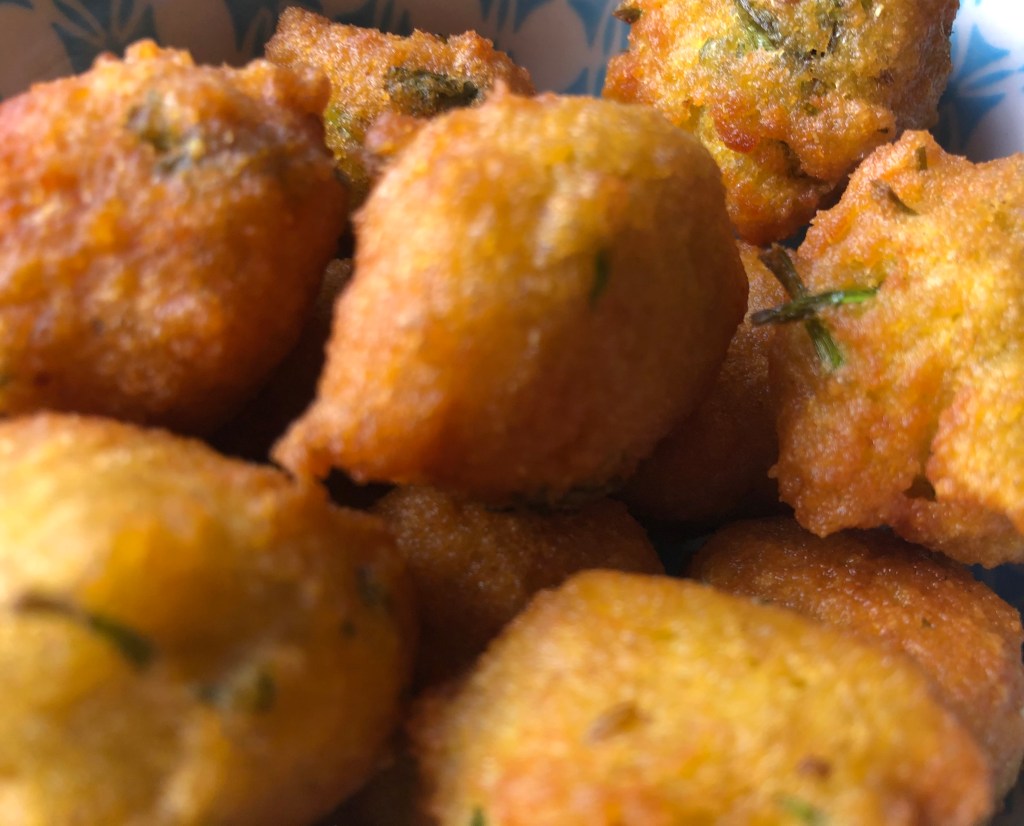
.

½ cup yellow-split peas, soaked in cold water for around 4-5 hours
½ cup plain (all-purpose) flour
1 teaspoon of bicarbonate of soda or baking powder
2 cloves garlic, peeled
½ teaspoon ground turmeric
½ teaspoon ground roasted cumin seeds
½ teaspoon garam masala
¼ teaspoon freshly ground black pepper
1 teaspoon of salt or to taste
3 spring onions, green parts only, finely chopped
1 red hot chilli, finely chopped, optional
vegetable oil such as sunflower, for deep frying

  1. Drain the split peas, reserving about ½ cup of the water. 
  2. Put the split peas, ¼ cup of the water and garlic into a blender and process until a thick batter. Add more of the water if, necessary, in order to obtain a thick batter. 
  3. Using a wooden spoon, stir in the dry ingredients until well combined.
  4. Stir through the spring onions and chilli, if using. 
  5. Taste a small amount of the batter and adjust seasoning, if needed. 
  6. In a wok or heavy-based pan, heat the oil until hot. The oil needs to be hot, before smoking point is ideal.
  7. Once you have the oil at the right temperature, you can begin to cook the pholouries. 
    Forming the pholouries:
    By hand: using your fingertips and thumb, scoop up a portion of the batter.  Using your thumb to swiftly transfer the mixture, lower it gently into the hot oil. The pholouries should float to the top immediately, this indicates that the oil is hot enough.  Allow the pholouries to cook until golden, turning with a slotted spoon so that they colour evenly.  
    Alternatively, you can use two spoons to drop the batter into the hot oil. With one spoon, take a spoonful of batter and lower the batter gently into the hot oil using the other spoon to slide it off.
  8. Drain on paper towels. Continue to cook in batches.
  9. Serve with a green mango or tamarind chutney or a good Caribbean hot pepper sauce.

Serves 4-6 as a snack

..

Pumpkin Curry

3 tablespoons vegetable oil, such as sunflower
1 medium brown onion, peeled and finely chopped
2 cloves garlic, minced
1 green chilli, (or a banana chili or scotch bonnet), finely chopped, optional
½ teaspoon ground turmeric
½ teaspoon ground cumin
½ teaspoon garam masala
¼ teaspoon freshly ground black pepper
1lb (500g) pumpkin (or butternut squash) peeled, seeded and cubed
around ¼ cup water
salt to taste

  1. Heat the oil in a lidded karahi or heavy-based medium sized saucepan.
  2. Add the onions and allow to cook on a low heat for around 10 minutes, stirring occasionally until they are a deep golden colour. 
  3. Add the garlic and chilli and cook for around 1-2 minutes, stirring regularly. 
  4. Add the spices and cook for around 5 minutes, stirring occasionally to prevent the spices from sticking and burning. 
  5. Add the pumpkin cubes and coat well in the spice mixture by stirring through. 
  6. Add the water and stir.  Cook with the lid on for around 20-30 minutes or until the pumpkin is very soft. Once soft, break up pieces using the back of a wooden spoon so that the pumpkin is mostly mashed.
  7. Serve with rice, paratha rotis or puris. Dhal also makes a good accompaniment.

Serves 4

..

From Letter to Marco Polo by Adam Aitken, Australia

MENU
Beef curry & Chicken curry & chutney
& dhal last night, tonight vegetable
curry & leftover Port Vindaloo with
cucumber & yoghurt as a
                                                 side dish,
Was it like this in Mountbatten's time - 
this anglo-Indian post-coital bliss??
Consider Newtown's very own Swami's motto:
"My cooking is the result of
Indian tradition & personal genius & charm"
(I misquote grossly but the sense is close.)
What better way to sniff fire
after a bad flu or too much Virginia Woolf
serialised on 2FC.    When Percival goes to 
                        INDIA
everyone gets pissed on nostalgia 
after bubbly & smoked salmon & 
sleeps with everyone else.    Dipti
(who's got a thrilling past in the
crazy Ceylon corridors of power) thinks
it's overdramatised.   When her Mum brings
a Red Cross parcel of  CURRY  &
a bottle of Rose Syrup we dream of
climbing Everest  /  flying high on
Hilary's vision of India, now going nuclear. 
 

A people’s art is the genesis of their freedom – Claudia Jones

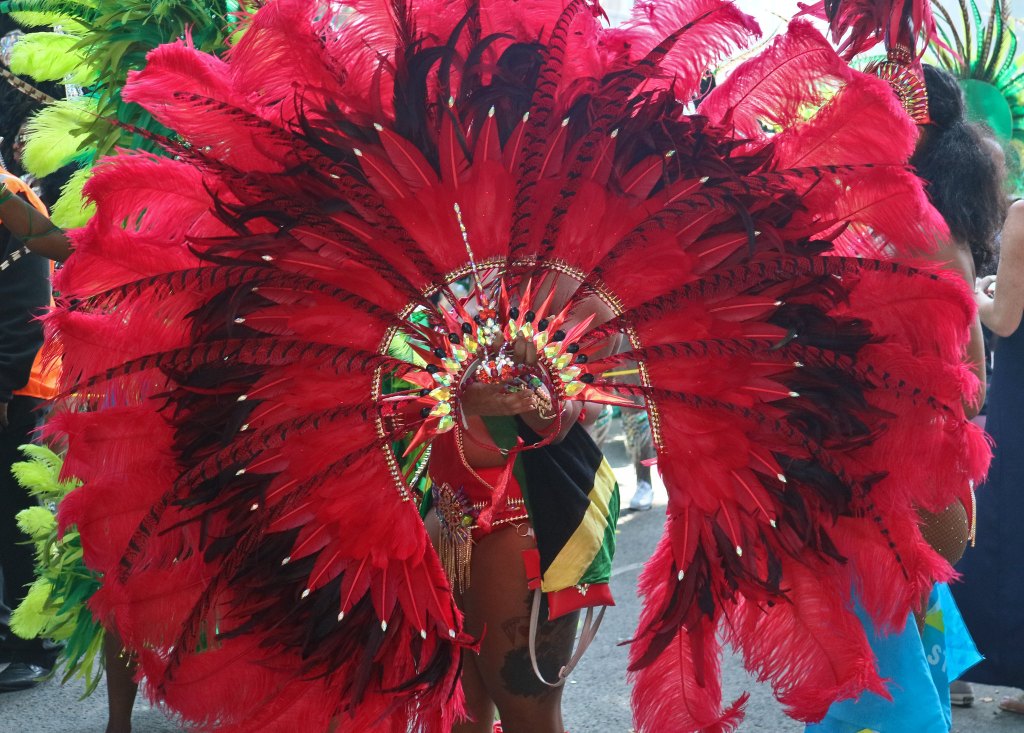
Covid-19 continues to attack us from all angles. For the first time since it began, Carnival went ahead without its street party. Instead, this year, the trail of steel pans, hypnotic percussion and circuit of sound systems was moved into the virtual space. It’s not just the music-filled streets of Notting Hill or the unity of a community, or even the spectacle and sparkle of the costumes and floats that we missed, but the food too. No jerk chicken this year!

Photographer Steve Eason

In truth, it’s probably not the first year that there hasn’t been smoking jerk barrel drums, neither is it the first time that Carnival has taken place off the streets. The first Carnival, back in 1959, took place indoors at St Pancras Town Hall, and in January, the peak of winter. Back then, tropical ingredients like allspice berries needed for jerk seasoning were hard to come by. It was also near impossible to buy ingredients for Caribbean specialities like Jamaica’s Akee and Saltfish (salted codfish cooked with indigenous ackee fruit) and Pepperpot (traditional Amerindian-derived dish from Guyana). Even so, Caribbean food was served at the event, dishes like chicken curry, roti, rice and peas and souse (spiced and pickled pig meat) made a show, reminding people of home.

Dried allspice berries

The carnival had been organised ‘to raise spirits to demonstrate resilience and celebrate Caribbean culture’ at a time when race attacks had sparked a wave of riots around Britain, including around Notting Hill, the year before. In response to the damaging effects the conflict was having on the black community, Trinidadian-born woman, journalist and communist party activist, Claudia Jones, organised the indoor carnival.  She wanted to do something that would celebrate West Indian culture and lift people’s spirits.

The year before, Jones had founded Britain’s first black newspaper, The West Indian Gazette. The Gazette had strong ideological commitments, and it connected the issues West Indian immigrants were confronting in Britain to the global struggles against colonialism and racism. It provided a space for writers to publish accessible commentary on their experiences and race relations in Britain, African independence movements, and on the US Civil Rights Movement. Jones wanted the newspaper to nurture a sense of cultural consciousness among West Indians, through its writers.

During the fifties, West Indian immigrants came to Britain at a time when the racist rhetoric of Oswald Mosely, British fascist politician was intensely popular. He appealed to a poverty-stricken white working class who bought into the idea of blaming migrants for their economic and social hardships. Unrelenting race attacks across Britain had spurred Jones to put on a soul-building event that would serve to bolster a black working-class battling with unemployment, low wages and discrimination at every turn. 

The event was immensely popular and attracted the support of activists, artists and writers. Among the artists present were Boscoe Holder, Fitzroy Coleman, Mighty Terror and Edric Connor. Jones was applauded for organising what at first seemed unfeasible, an indoor carnival. Her energy and instinct for timing was one of her many gifts. At the time, the Carnival stage manager, political activist and socialist, Trinidadian Trevor Carter, said “Claudia, unlike the rest of us, understood the power of culture as a tool of political resistance. The spirit of the carnival came out of her political knowledge of what to touch at a particular time when we were scared, in disarray.” 

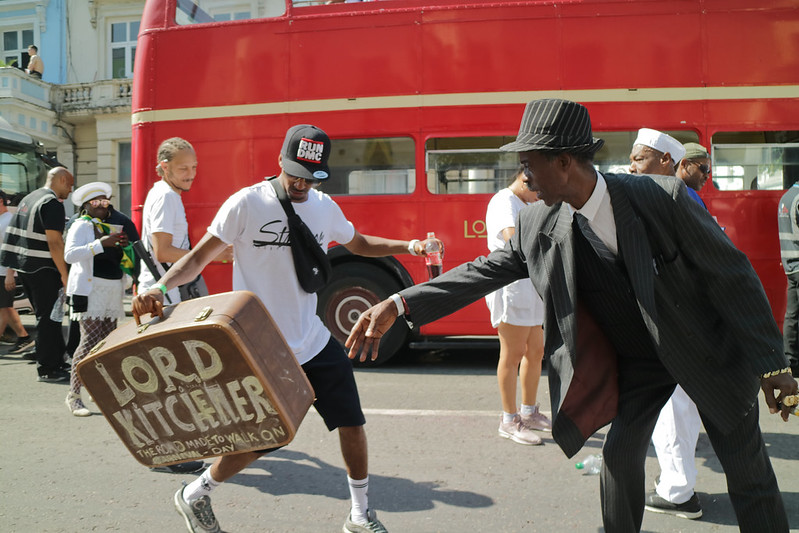
The following year, Carnival was held in a larger venue, the Seymour Hall, Marble Arch. It headlined with calypso genius, Lord Kitchener and actor, Cy Grant. Writers Samuel Selvon (The Lonely Londoners (1956)) and George Lamming (The Emigrants (1954)) were on the panel for the beauty queen pageant. And the event’s popularity grew in the two years that followed, moving each time to larger venues: Porchester Hall and then the Lyceum Ballroom.

It wasn’t until 1964 that Carnival moved to the August Bank Holiday and onto the streets. Although, Jones was not involved in organising it, the event followed through her ambitions to bring together community through its culture. The street party came about because Ladbroke Grove social worker and community activist, Rhaune Laslett, wanted to organise outdoor festivities for local children from various ethnic groups. She was of mixed Native American and Russian descent, and, she too had wanted to lift the children’s spirits.

Musician extraordinaire, Russell Henderson, worked alongside Laslett, and was pivotal in setting up what was to become Notting Hill’s first Carnival. They enlisted musicians and children’s performers to attend what was described as a ‘street party’. Laslett wanted “to prove that from our ghetto there was a wealth of culture waiting to express itself, that we weren’t rubbish people”.

The local council had granted Laslett permission for an outdoor party to take place and had agreed to cordon off part of Portobello Road. Once the festivities kicked off, with music from the Russell Henderson Steel Band and performances from kids entertainers, it took on its own momentum. Taking off down Ladbroke Grove, it grew fast as local West Indians joined in with the music and dancing. White British onlookers were also drawn into the parade.

From children’s street party it turned quickly into a parade. The ‘carnival’ partied on down past Holland Park and beyond the cordoned area, managing a much bigger circuit than agreed with the council. Since Jones and Laslett’s successes, the Notting Hill Carnival has taken place every year, continuing to be a space where the black community come together to perform, party, eat and defend their civil rights. Although, the Carnivals that followed those early years were not without obstacles.

The sixties brought its own challenges, not least with the Enoch Powell River of Blood speech on 20 April 1968. If anything was going to consolidate a civil rights movement in Britain, it was a venomous populist orator like Powell. He fed the insecurities of the white British unemployed and working class with his anti-migrant and nationalist speeches, not dissimilar to some of the commentary heard around Brexit today.

By the seventies and beyond, Carnival increasingly became a meeting point of police brutality and the disillusionment of young black and Asian people. Britain was blatantly failing its second generation West Indians, with many feeling alienated by British institutions and subjected to high unemployment rates. The Met Police constructed a stereotype of young black men as criminals, using and abusing stop and search laws to harass and provoke.  Police and Thieves by Jnr Murvin and Lee Scratch Perry become a symbol of that conflict and an anthem at Carnival. 

My own first experience of carnival as a child was of a lively musical colourful moving show, jaw-stopping costumes and a deep bass that reverberated through my roasted sweetcorn. Add to that memory, mixed feelings of fun and fear; and breaking into a sprint when the police charged the crowd, and my parents holding on tightly to my hand as we ran, until we reached a safe corner.

Photographer Steve Eason

Over the years, carnival has grown from its black community base, galvanised first by Claudia Jones and later by Rhuane Laslett, into the largest street festival in Europe. Without the musical thread of calypso, reggae, dance hall, soca, chutney, dub and ska giving expression to a growing black political consciousness, British culture would look very different today. For me, Carnival’s music expressed the West Indian experience in Britain and unified the voice of protest. Without it, we couldn’t have had the political expression or call for black and white to unite against racism in the lyrics of two-tone, jungle, hip hop, garage, grime, rap and more. 

This year, had Carnival gone ahead on the streets, the same defiant confrontation of oppression that Jones had pioneered through her writing, activism and support, would have been headlining in lights on centre stage. From Carnival’s civil rights and community activist roots, we have a strong and important tradition that continues to be relevant and significant. The Black Lives Matter movement would have been visible and present in the people, music and parade, loud and proud.

Despite the absence of the street carnival, there were socially-distanced, mask-wearing demonstrators marching in Notting Hill last Sunday in the Million People March. They were demanding respect, justice and dignity. They were mourning too, the human loss, caused by a global system that fails the black community and asylum seekers and refugees. From the streets around Portobello, the demonstrators’ aim was to bring together all the different communities calling for change, just like carnival’s foremothers had, the women who started it all.

..

Wonderful World, Beautiful People – Jimmy Cliff – Released 1969

Take a look, at the world 
And the state that it’s in today 
I am sure, you’ll agree 
We all could make it a better way 
With our love put together 
Everybody learn to love each other

 
Instead of fussing and fighting 
Cheating, backbiting 
Scandalizing and hating

Baby, we could have a
Wonderful world, beautiful people 
You and your girl things could be pretty

But underneath this, there is a secret
That nobody can reveal

..

Rest in Power, George Floyd
Rest in Peace, Mercy Beguma

Rest in Peace, Chadwick Boseman, King

..
..

Carnival feeds thousands of people each year as they party through the bank holiday weekend.  It’s brought the food of the West Indies to the streets of London. Jerk pits park up on road corners and stalls set up selling Trini rotis and Guyanese Pepperpot on Notting Hill’s gentrified streets. If you missed your fix of Jamaican jerk chicken this year, I’ve included a recipe for fans. To keep it real, make sure you get hold of its characteristic blazing scotch bonnets. The flavour is only matched, (or surpassed even?), by the Guyanese wiri wiri pepper.

Jerk cooking is a testimony to slave rebellions and unity on the island of Jamaica. The indigenous Tainos, living on the island before European colonisers arrived, were long using a type of smoking and barbecuing to cook meats. Later, freed slaves, formerly from African nations, formed a rebellious community, the Maroons, that united with the Tainos against the British and their enslavement and exploitation. Once the British formally accepted defeat, the Maroons settled, and ‘jerk’ cooking developed into a style of cooking that focussed more on flavour and less on food-on-the-go. Using Taino methods, meat was cooked with smoke and heat, and allspice tree branches to fuel the fire. Local hot peppers were later added to create a seasoning resembling the smokey and spicy jerk seasoning we know today.

Jerk Chicken

Jerk Seasoning:

25g/¼ cup dried allspice berries (also known as pimento)
1 inch cinnamon stick
1 teaspoon freshly grated nutmeg
½ teaspoon freshly ground black pepper
1 teaspoon dark brown sugar
6 spring onions (green onions) including green parts, roughly chopped
6-8 large celery leaves (optional)
1 large sprig of fresh thyme, use only the leaves
2/4 cloves of garlic, peeled and crushed
1 small onion, peeled and quartered
3 scotch-bonnets, seeded and halved
juice of ½ lime
salt to taste

around 1kg chicken pieces
2 tablespoons vegetable oil

Traditional mortar and pestle method: You can make the entire jerk seasoning in a large mortar and pestle, instead of using a spice blender and food processor.

  1. Pre-heat oven 350oF. Place allspice berries in a non-metal ovenproof dish and roast in the oven for 5 minutes. Remove and allow to cool.
  2. In a spice blender, or mortar and pestle, grind the allspice berries, cinnamon and black peppercorns until ground. Add the grated nutmeg to the spice blend.
  3. Place the spring onions, onion, garlic, scotch bonnets, celery leaves, thyme leaves only, sugar and lime juice into a mini food processor and blend until all the ingredients are minced. Transfer to a small bowl and add the ground spices. Season with salt.
  4. With a sharp knife, pierce the chicken pieces several times.
  5. Add the jerk seasoning to the chicken and mix well. Leave covered and refrigerated to marinate for around 3-4 hours, or overnight if time allows.
  6. Cooking:
    In the oven: Pre-heat oven to Gas 6/200oC/400oF. Put the oil in a roasting dish and spoon half of the marinade on top. Bake in the middle of the oven for 20 minutes. Reduce temperature to Gas 3/170oC/325oF and cook the chicken for around 45 mins -1 hour. During cooking, baste the chicken pieces with the pan juices.
    On the bbq: Prepare the bbq to a high temperature (around 400oF) and first seal the meat pieces on both sides. (This can be done directly above the coals.) Ideally, a covered bbq is best, or you can cover an open bbq loosely with aluminium foil. Then, put the lid down (or cover with foil) on a drum or kettle bbq with vents slightly open, and reduce heat to low (325oF) with the lid down for around 1 hour or until chicken is cooked through. Or use indirect heat, by pushing coals to the side. This will prevent flare ups.
  7. Traditionally served with rice and peas or good on its own with an iced cold beer.

Serves 4

Bibliography:
Sounds Like London, Lloyd Bradley, Serpent’s Tail, 2013
History Today, Jerk an Authentic Taste of Jamaican Liberty, Alexander Lee, Volume 69, 5 May 2019

Cuba’s isolated kitchen

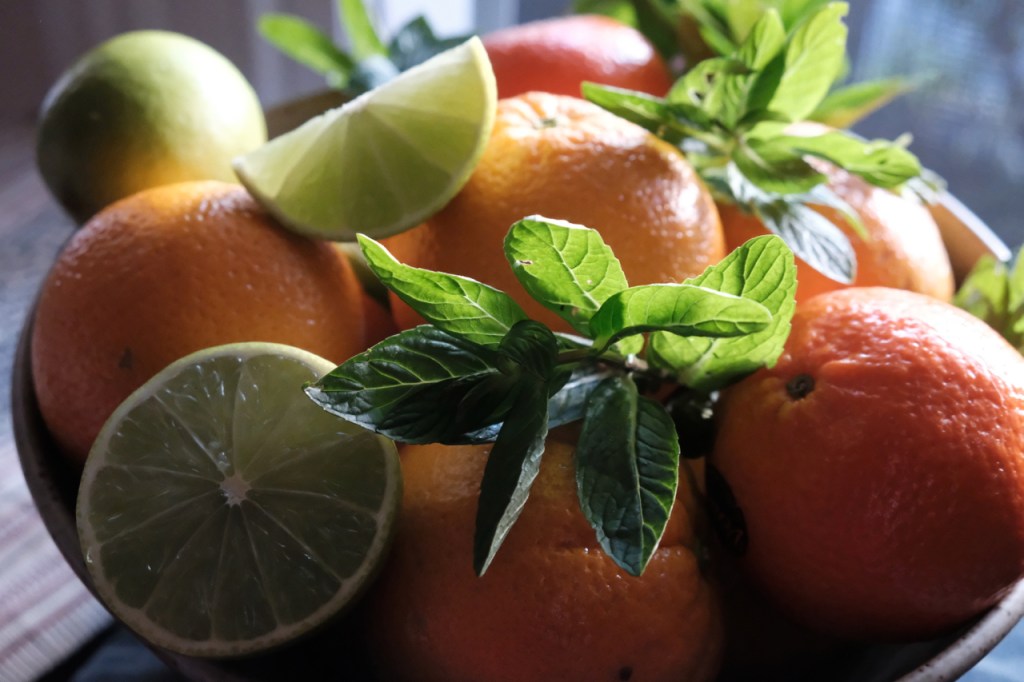
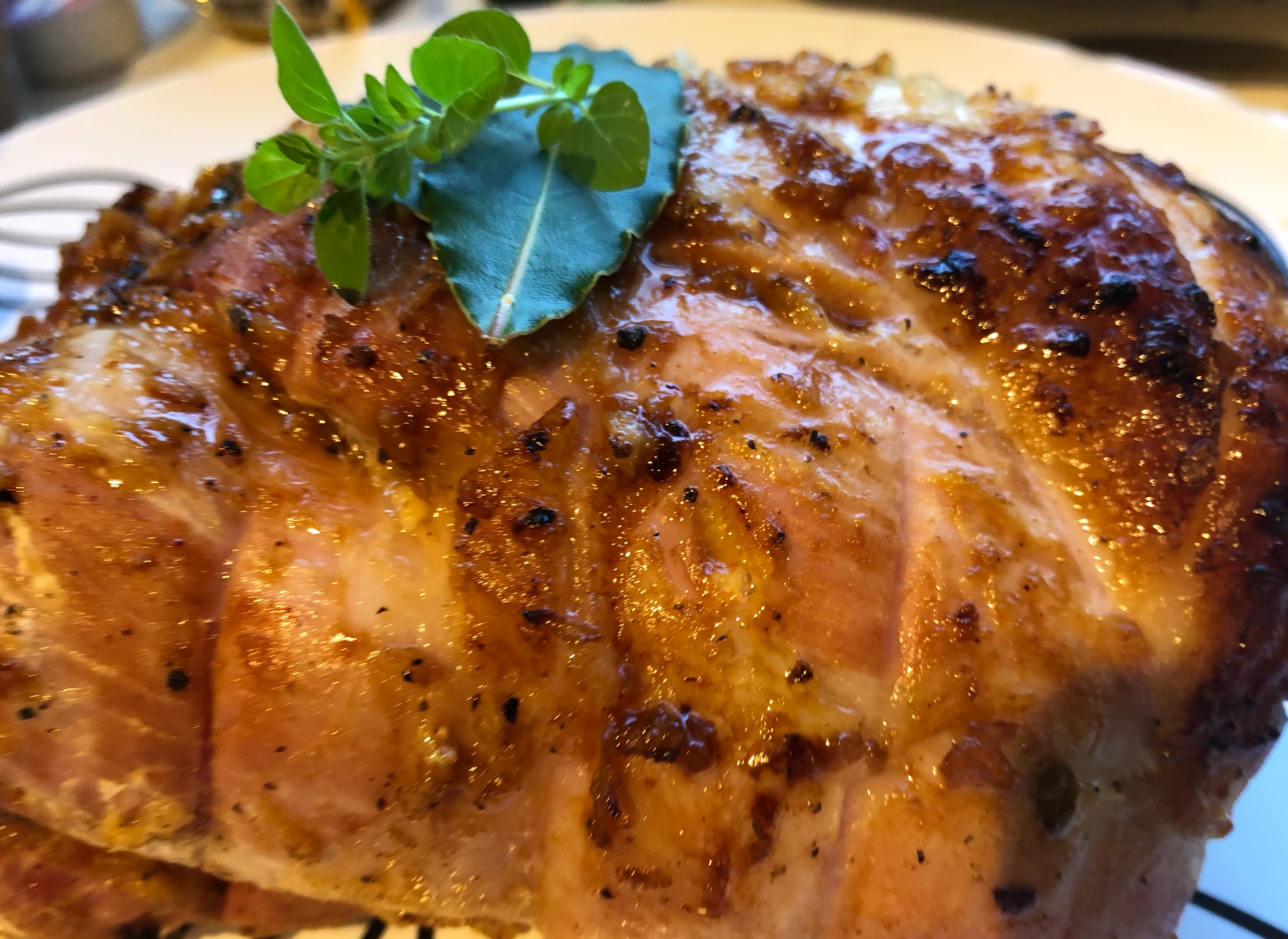
Yesterday, I decided to make a Cuban cerdo asado (known also as lechón asado outside of Cuba), roast pork. I was inspired by the fruit in my kitchen. Out of the corner of my eye, I caught bright limes blur into two bergamot lemons against fully ripened oranges. The collective zests reflecting a light only the impressionists know how to capture.  

Photograph by poet, writer & food photographer, Adam Aitken, Australia

Their citrus allure led me to put together the marinade for the cerdo asado. Traditionally made with Seville oranges (bitter oranges), that I unfortunately cannot buy, I made do with combining lime and lemon juice to sweet orange. Once added to the pork, its best left refrigerated overnight, if time allows.  I gathered the ingredients: fresh oregano from the garden (dried is also very good), garlic, my oranges, limes and a lemon, bay leaves and black pepper, and sometimes, I add a little cumin. 

I am an aficionada of Cuban food which I note has been deconstructed and reconstructed over recent decades, often leaving the newcomer to Cuba wondering what all the fuss is about. It’s inevitable that some travellers may come away disheartened by their experience. Having had the gloss of intoxicating mojitos and the nostalgia of specialities like empanadas and tamales, promised in the travel branding but that fail to show. 

The reality is, the visitor’s dining experience begins with a brutally cropped version of a traditional Carte du Jour. Cuban food at the present time is a shadow of its former selves and has been for some time. With long queues to get staples and a limited range of food choices, it’s not surprising that the visitor comes away without the full picture. Whether they chose the Nacional restaurant, looking over Havana’s Malecon, or dine in the cafes amid the contagious beats of Santiago de Cuba’s revered music scene, there is little choice. An abridged recurrence of ingredients read as a precis of a real Cuban menu.   

Since achieving its acclaimed Revolution in 1959, Cubans have faced multiple setbacks to date. Hostilities and extended hardships have plagued post-revolution Cuba and its leadership. Marred by the fallout from capitalism’s continued hysterics, Cuba has had to curtail doing business with just a handful of trading partners. Families and cooks island-wide and across generations have suffered the consequences.  

A fusillade of embargoes and economic blockades, isolationist policies, as well as the parting of ways with old aid and trading friends has been unrelenting for Cuba. Burdened by economic barriers and subject to skewed leadership, Cuban cooks have had to learn new ways of cooking traditional recipes and to make do with limited ingredients. The highs and lows of supply plot how Cuban cuisine has and is taking shape in a country where the land is fertile but resources are few. 

In the current climate, the lows last longer, compounded by Venezuela’s crises as well as the impact of decisions made by a long time acquaintance. Segue to the current US leader. Executing his policies with buffalo-finesse, he has ordered a wind back to pre-Obama times in relation to Cuba. The progress the Obama administration made in resuming diplomatic ties, allowing Cuba to export its world-renowned rums and cigars, has been reversed and old restrictions have returned. 

Cuba is back to dealing with a vengeful neighbour who has packed up his toys and taken them home, again. With Monopoly-mentality, he has withdrawn the Marriott hotel and ceased play. By contrast, it comes as no surprise that a country whose people have repeatedly garnered the will, expertise and determination to take on their imperialist ex-friend, has impressive control of Covid-19.  If only they had exchanged notes. Cuba could have shown the US how they prepared two months prior to their first detected case, how they actively screen, and how their very strong primary healthcare system has been a major factor in controlling their outbreak. But still, the US has Cuba to thank for the dazzling Cuban fare found on its soil. 

Following the Revolution, the secrets to Cuba’s deep-rooted culinary traditions were smuggled out. Stuffed into bourgeois suitcases packed last minute, they were carried in boats pulled in by Florida’s tow ropes.  Drawn to the attraction of surplus and their host’s open-arms reception, a welcome preserved only for defectors, the migrants unloaded and assimilated into American life. 

Taking their first step onto western democratic soil, and at ease with the entrepreneurial spirit that made America great, they set about realising a profit from their recipes and knowhow, among other things. So began the wave of predominantly middle-class Cubans into the US, who had shirked the Revolution. Most diffused into the long-time established Cubana community in Miami; made up of tobacco factory labourers, artisans and contract farm workers. 

Miami’s Little Havana, had been first populated and built by economic migrants. They were fleeing poverty long before the revolution, and during the time when rich Americans traded their meagre dollars for Cuban souls. The area was later expanded by counter revolutionaries. Setting up their homes, cafes and restaurants in and around the area, the newcomers commemorated their new life with culinary invention: Miami’s infamous Cuban Sandwich. A testimony to their exodus.

Little Havana lays just a few sailing hours away from the mother country, where cooks continue to adapt or create recipes in their sparse kitchens. Surrounding the streets around Calle Ocho, bustling bars and eateries trade in stark juxtaposition to the scant restaurants across the straits in Santiago de Cuba, Varadero and Havana, Cuba’s tourist hot spots.

It was in Little Havana, that I found signature dishes like ropa vieja and picadillo that were either completely absent in Cuba or adapted to availability. Here staff served in restaurants decked out like ‘home’ and decorated in colourful artwork. I found a fantastic cafe, where Cuban son dropped infectious latin beats while customers perused an impressive menu. Steaks were served with the ubiquitous mojo criollo (fresh garlic sauce). Seafood such as lobster was in abundance, lechón asado was served with sliced yuca, sautéed plantains and a rich recipe of frijoles negros (black beans) or, the historically named, moros y cristianos (black beans and rice, or Moors and Christians).

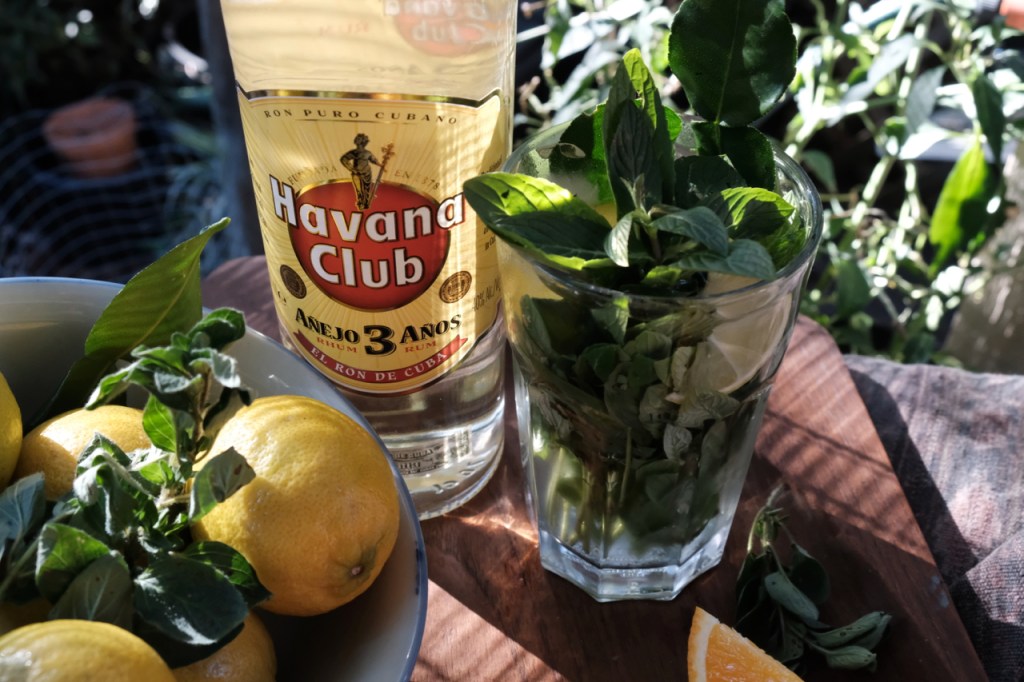
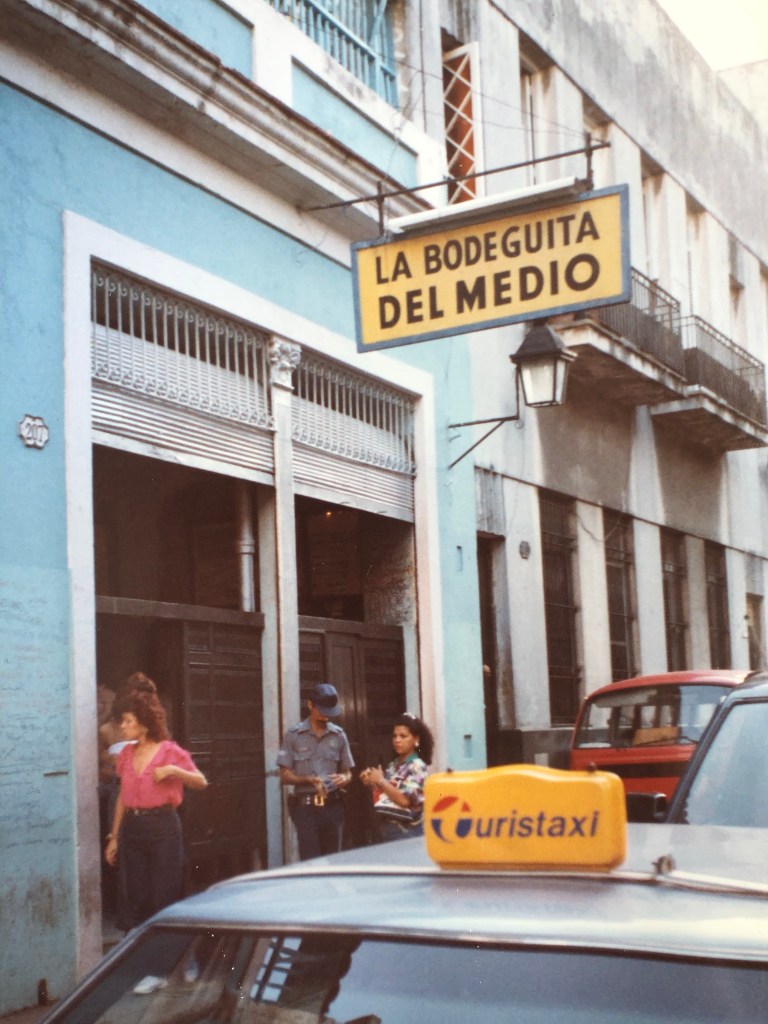
Back in Havana, I had found that some old classics remained largely intact. But they were mostly in the honoured restaurants of Hemingway’s choice, La Bodeguita del Medio and El Floridita. Among the few recipes that remained true to their origins, were the cocktails and drinks. In El Floridita, I had a beautiful margarita in 1950’s style. In the Nacional bar, I sipped on Cuba Libres with fresh limes slices afloat. Not to be missed was the fresh yerbabuena (Cuban mint) crushed in cane juice, doused in a sea of golden Cuban rum, topped in a highball with soda water and slices of lime. The Mojito. The fragrance of yerbabuena against the rum’s heady molasses is sheer genius in a glass. 

The afficionadas among us, rate Cuban food highly, both outside as well in, despite the shortages. On a visit to Havana, I was fortunate to meet a local cook and abuela (grandma), Angélica Suarez. She showed me just how good the food is, still. She had been cooking traditional Cuban food long before the Revolution. In her Havana apartment, she was holding together childhood traditions while successfully creating minimalist versions of old recipes where ingredients were scarce. 

Angélica showed me how to make her unforgettable sopa de pollo (Chicken Soup). She also taught me how to begin the dish with a sofrito.  From her, I learned that adobe (seasoning), an inherent component of meat and fish cookery in Cuba, mirrors the method of Guyanese home-cooking I was taught. Indeed, seasoning (or marinating), is a widely used precursor to preparing meat and seafood dishes in the whole of the Caribbean. Angélica seasoned her chicken with an adobe made of crushed garlic, oregano, paprika, olive oil and salt and black pepper. 

The Cuban sofrito is also very similar to that of many Caribbean recipes, with the exception of the herbs used.  Mediterranean herbs and ingredients are characteristic of a Cuban sofrito. Chopped onions, spring (green) onions, garlic, tomatoes, peppers, oregano, parsley, bay leaves and variations thereof make up a sofrito.  The chicken pieces were cooked gently in its adobe, the sofrito and stock. Angélica later adds plantains, sweet potatoes, carrots and noodles to complete the sopa de pollo.  The result was a wonderful, heart-warming dish executed with technique and steeped in layers of flavours. 

I later went on to discover lechón asado in a paladar, a small in-home restaurant, in Havana’s backstreets. We found the place on a narrow residential street where we were beckoned by a couple to go inside. They welcomed us from their doorstep, as though we were personal guests.  We were promptly directed to sit in the front room at one of two small round tables covered in red and white gingham tablecloths.

The hosts were the cooks, a content couple in their thirties, who were earning a living from tourism. They served us a lesser version of lechón asado, which is traditionally made with a suckling pig, on a bed of arroz con frijoles negros (rice and black beans) with yellow plantain slices.  The strength of the characteristic bitter orange seasoning had been toned down, yet the pork was roasted to texture perfection and suffused with a robust mojo criollo.  

The host told us that Cuba had known better times, and not that long ago either. She went on to talk about how she usually made her lechón asado, that is when ingredients are aplenty.  It was a fascinating snapshot of criolla cooking, the triangular meeting point for Mediterranean citrus and herbs and an Afro-Cuban style of cooking meat with indigenous food. The addition of black peppercorns and cumin seeds completes the history; spices brought to Cuba by Iberian conquistadors via traders.  

Although it was not easy to come by old traditional recipes in Cuba’s cafes and restaurants, I was impressed by the food I had eaten. It epitomised the place in time and the passion people have for their cultural identity. In everything I tried, whether it was a cocktail, contrived in part at least for the tourist, or a homemade meal, I experienced a strong and proud sense of Cuba’s culinary and national heritage. When economic burdens lift, Cuban chefs are doing what chefs do everywhere, taking in global trends and influences while preserving their traditional cocina criolla.

Cerdo Asado (Roasted Pork)

6 lb fresh unsmoked gammon or pork shoulder 
8 cloves garlic
2 teaspoons salt
1 teaspoon whole or freshly ground black peppercorns, (or ground black pepper is fine)
1 and ½ cups bitter orange juice* (If you can’t get bitter orange juice, use one cup of sweet orange, ¼ cup lemon and ¼ cup lime)
2 teaspoons fresh oregano leaves or 1 teaspoon dried oregano
2 bay leaves, roughly broken
½ teaspoon ground cumin
1 and ½ cups olive oil

*bitter orange juice comes from Seville oranges. If you cannot get bitter (or sour) oranges substitute half of the sweet orange juice, mixed with one quarter fresh lime juice and one quarter of fresh lemon juice. 

  1. Wash the pork and pat to dry. Pierce deeply around the pork with a sharp knife. Place in a lidded bowl or container.
  2. In a mortar and pestle, crush the garlic with the salt and peppercorns (if using whole peppercorns) until it becomes a paste. If using ground black pepper, add now and stir. 
  3. Take half the garlic paste mixture and rub all over the pork. 
  4. Transfer the remaining garlic paste to a small mixing bowl and add the bay leaves, cumin, olive oil and citrus juices to make the marinade. 
  5. Pour the marinade over the pork and marinate in the fridge, preferably overnight. Rotate the pork or turn the lidded container upside down at regular intervals to ensure all of the meat is evenly marinated.
  6. Remove meat from the fridge around an hour before roasting. 
  7. Pre-heat the oven at gas 3/170oC/325OF
  8. Place the pork in a non-reactive roasting pan, fat-side up and cover loosely with aluminium foil. Set aside the marinade. Cook for around 3 hours, (until the internal temperature reaches 170oF).
  9. While cooking, frequently spoon the reserved marinade over the pork and baste with pan juices. 
  10. Remove foil and continue to cook for 2-3 hours, until the pork is soft. Baste pork in pan juices. 
  11. Remove from oven, cover with foil and allow to rest for 10 minutes before serving. Serve with mojo criollo (garlic sauce).

Serves 6-8

Serve with black beans and rice, sautéed yellow plantains (for recipes see The Complete Caribbean Cookbook for recipe). To make the famous Cuban Sandwich use roasted pork slices.  

Mojo Criollo
6-8 cloves garlic
½ teaspoon salt
1 small onion, very thinly sliced
½ cup bitter (Seville) orange juice* (see above)
¾ cup olive oil

  1. In a mortar and pestle or using the back of a knife, crush the garlic with the salt until it becomes a paste.
  2. Transfer to a small mixing bowl and combine onion and citrus juices. Allow to infuse for around 30 minutes.
  3. In a small pan, heat the oil until just hot, not smoking.
  4. Take off the heat and pour over the garlic mixture while stirring briskly.
  5. Serve with credo or lechón asado (roasted pork).

Makes around 1 cup

Variations: finish with ¼ teaspoon freshly ground black pepper and/or ¼ teaspoon dried oregano.

National Windrush Day

Today is National Windrush Day, a day to honour the British Caribbean community, who arrived between 1948 and 1971.  My family are part of the generation of West Indians who came to Britain during that time, to help repair post-war Britain in the 1950s. So today, I’m taking a little time out to reflect on this day and on my family’s migration to the UK. 

Having chosen to make London their new home in the 1950s, my grandparents anticipated a new and prosperous life in a land promising hope to generations. They set sail from Guyana’s tropical shores for London’s cooler climes. Their first cultural adjustment was the weather. Bitterly cold winters, with snow almost knee-deep in Finsbury Park had them questioning the joy and laughter promised to them on glittered Christmas cards.  Winters in London turned my Grandma into an expert in layering and insulating the body, making us leave for school in Michelin-man style. 

Naturally though, there were highs and lows to uprooting to a new country. The Windrush story can’t truly be told without acknowledging that racism hindered the ease within which the Caribbean community settled in. I know my grandfather regularly questioned why they had been allured to Britain, with its enticing advertising, when the reality was they were faced with barriers when trying to set up the most basic needs of a family, such as housing. Back then, it was standard to see signs displayed in windows saying ‘No Irish, no blacks, no dogs’. 

The fight for equality and justice was always an undercurrent for the Windrush generations, and remains so. Yet, as I begin to surmise what it means to celebrate Windrush day, as a first-generation Guyanese, I think about the West Indian community as having intrinsically helped to shape what is British culture today.

Growing up in London, the Notting Hill Carnival was, for me, Windrush Day. The music, the smell of jerk chicken, sautéed plantain and saltfish, the taste of Guinness punch, and the colours, the lively shades of the islands. All of this was an emblematic celebration of the achievements of the diaspora. Sound systems stacked in the streets of Ladbroke Grove and Portobello Road, transformed west London into a Caribbean carnival for a whole day. People came together on a summer’s bank holiday with Soca, Chutney, Ragga, Reggae and Rap vibrating deep into the soul.

When I take carnival out of the experience, I see my family and community settling in a place that they were both shaping and confronting.  I see also my grandmother, a strong woman, gathering strength and resilience along the way. She, like other West Indians, made and sustained a life in Britain, a good life at that. Once she had worked through the tangled turmoil of British society, with all of its contradictory standards, she had a happy life. She belonged to a community with shared experiences, and spent time with friends and family, who she cooked for and laughed with, and cried with too.

This Windrush day, I pay respect to the generations who paved the way for us, and made it easier for my generation. I also celebrate the Caribbean heritage kept alive through families, grandparents and great grandparents. Today, of all the wonderful places I have been fortunate to live in and visit, with all their beauty and serenity, my favourite place in the whole world to be was at my Grandma’s kitchen table. The brightly coloured floral tablecloth, her kitsch salt and pepper shakers and homemade chutney, all props for the centrepiece, her life’s stories in Guyana. After cooking and eating together, followed by a dessert always served with ice-cream or custard, the radio playing, we would sit there for hours, just limin’.  

..

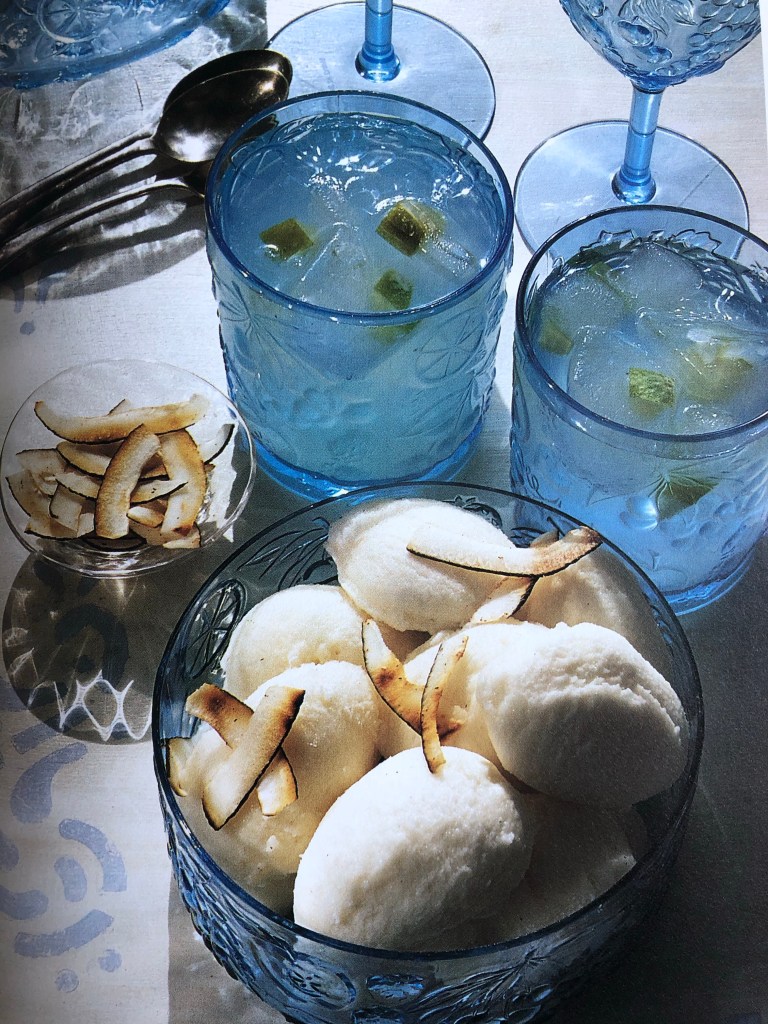
Coconut Ice Cream

Photo by Michelle Garrett, food stylist Liz Trigg, from The Complete Caribbean Cookbook by Pamela Lalbachan

1 cup (8 fl oz/250ml) fresh coconut milk
1 cup (8 fl oz/250ml) fresh milk
3 tablespoons cornflour (cornstarch)
1 cup (8 fl oz/250ml) caster (superfine) sugar
1/4 teaspoon salt
2 tablespoons grated coconut
2 egg whites, beaten to soft peaks

.

  1. Combine coconut milk and halt the milk in a medium saucepan.
  2. Combine remaining milk and cornflour and add to the saucepan with the sugar and salt.
  3. Cook over a medium/low heat, stirring constantly, until the mixture forms a thick custard-like consistency.
  4. Stir in the grated coconut. Allow to cool.
  5. Pour the mixture into a lidded container, cover, and place in the freezer until it is partially frozen.
  6. Transfer the mixture to a large bowl, add the egg whites and beat until smooth. Return the ice-cream to the container and freeze for 3 hours, then beat again until smooth and creamy. (Alternatively, freeze in an ice-cream maker following the manufacturers instructions.) Return to the freezer until the ice-cream is frozen.

Serves 4