
“Certain emotions bridge the years and link unlikely places.” V S Naipaul, Trinidadian writer
I started writing this blog, inspired by Diwali and the food and warm feeling I associate with it. Although it is a Hindu Festival, it is not the religious aspect in particular that I feel connected to, rather it is a sense of heritage and identity that move me. Lakshmi, who is honoured by Diwali, sat among the revered murtis (statue of a deity) in my Grandma’s living room, and together, the two of them made Diwali a lasting family tradition. They created a sense of belonging and hope when Diwali-time came around, which I have kept and carry with me.
According to the Times of India, Indians make up the largest population living outside their country of birth. It‘s no surprise when you look at the back story that there are now around 18 million migrants living abroad. The expansion of the British Empire, as well as that of its European imperialist cousins’, resulted in the making of one of the world’s significant Diasporas. Together, and often in agreement, they transported thousands of Indian labourers to the Caribbean, Africa and parts of the South Pacific and South Asia from 1830s to 1920s. It is through these ancestors that Indian religions, customs and beliefs have sustained, and sometimes, evolved outside of India.
The popularisation of many religious events and festivals around the world, has put Diwali, among other celebrations, on the international calendar. Around this time of year, Indian recipes and ingredients appear in the supermarkets’ glossy magazine specials and television food shows are brimming with Indian cooking content. Long-time chef, Mary Berry, widely renowned for her British baking and cooking, recently departed from her regular format to visit a London-based family celebrating Diwali in her current television series.
In spite of an increased market culture of commercialisation and promotion, it is the Disapora’s deep rooted affinity with Mother India that its descendants have honoured and conserved. Through the generations, the Diaspora has cultivated an unbreakable sense of self which I see in Indian families and communities. I learnt of it too, in a subtle philosophy that infused my childhood with the small things in daily life and beliefs and thoughts that belong to an Indian-ness. While Guyana was the place we as a family were from, I understood that so too are we from India. It was this duality that, universally, older generations had to reconcile. Now, generations on, add in another migrant journey and I am also a Londoner.
In lockdown-London, for this year’s Diwali I was a bit ambitious. I’d made a trip to my favourite supermarket with a long list of dishes in mind that I had planned to prepare. I bought ingredients you would undoubtedly expect for the occasion: fresh coriander and fenugreek, garlic, ginger and turmeric roots, ghee (clarified butter), besan (ground chick-pea flour), okra, potatoes, aubergine and more. But I also made sure to get some pumpkin, guavas and scotch bonnets because the Guyanese, and in fact, the Trinidadians and Surinamese version of Diwali has a distinctive Caribbean lilt.
..

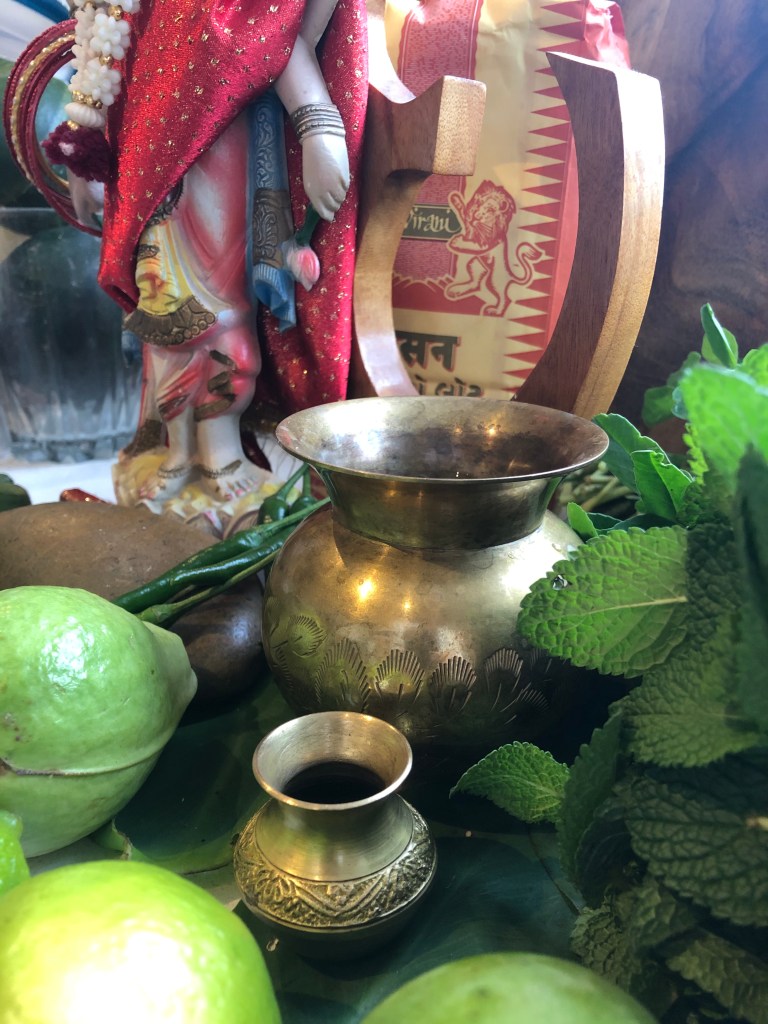

I had planned to make a green mango chutney to go with poulouris (spiced yellow split pea batter with spring onions and deep fried into balls), unmistakably an Indian-derivative street snack and found only in the Caribbean, as with dhal puri (a roti filled with spiced ground yellow split peas) and baiganee (aubergine slices deep-fried in a spiced batter).
Despite having helpers, I never got to the mango chutney or the baiganee. By the finish though, I had managed something of a feast. The dining table was graced with dishes and sweets from Guyana having made their way there from India many moons earlier, and somewhere in there was probably a little London-ness too.
Below, is my offering to you: two favourite recipes that always appear in the family Diwali feast. I hope you enjoy them, all year round.
..
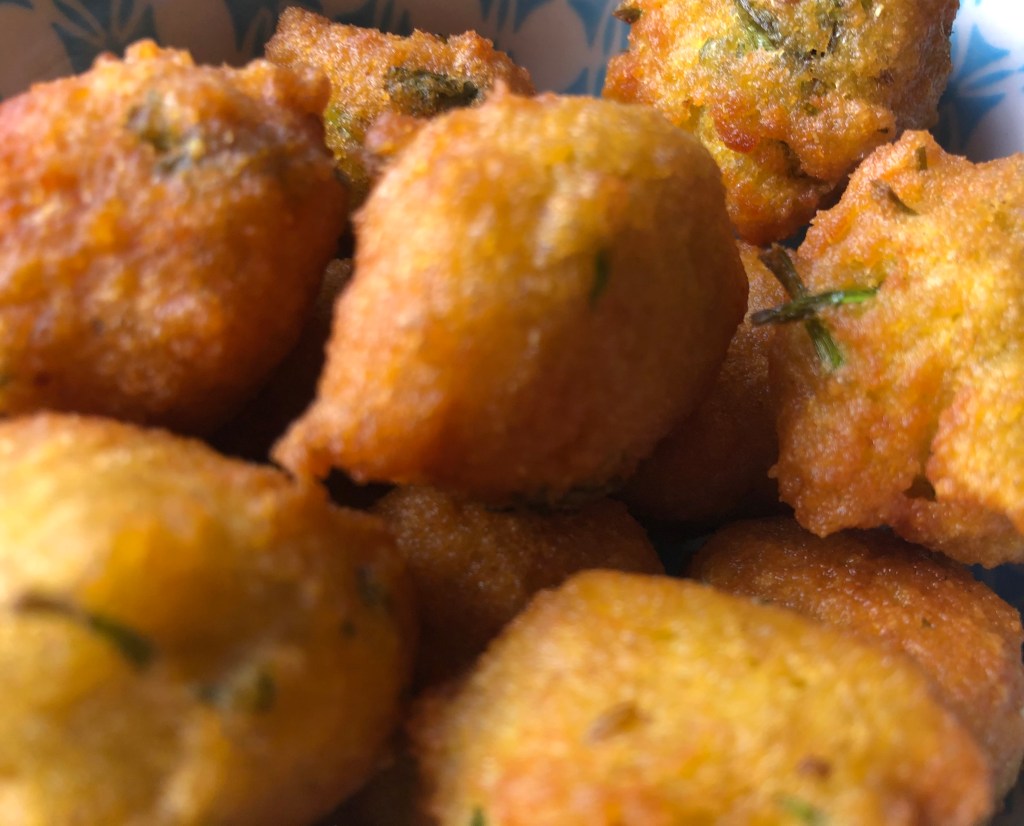
Pholourie (spiced yellow split pea balls)
.
½ cup yellow-split peas, soaked in cold water for around 4-5 hours
½ cup plain (all-purpose) flour
1 teaspoon of bicarbonate of soda or baking powder
2 cloves garlic, peeled
½ teaspoon ground turmeric
½ teaspoon ground roasted cumin seeds
½ teaspoon garam masala
¼ teaspoon freshly ground black pepper
1 teaspoon of salt or to taste
3 spring onions, green parts only, finely chopped
1 red hot chilli, finely chopped, optional
vegetable oil such as sunflower, for deep frying
- Drain the split peas, reserving about ½ cup of the water.
- Put the split peas, ¼ cup of the water and garlic into a blender and process until a thick batter. Add more of the water if, necessary, in order to obtain a thick batter.
- Using a wooden spoon, stir in the dry ingredients until well combined.
- Stir through the spring onions and chilli, if using.
- Taste a small amount of the batter and adjust seasoning, if needed.
- In a wok or heavy-based pan, heat the oil until hot. The oil needs to be hot, before smoking point is ideal.
- Once you have the oil at the right temperature, you can begin to cook the pholouries.
Forming the pholouries:
By hand: using your fingertips and thumb, scoop up a portion of the batter. Using your thumb to swiftly transfer the mixture, lower it gently into the hot oil. The pholouries should float to the top immediately, this indicates that the oil is hot enough. Allow the pholouries to cook until golden, turning with a slotted spoon so that they colour evenly.
Alternatively, you can use two spoons to drop the batter into the hot oil. With one spoon, take a spoonful of batter and lower the batter gently into the hot oil using the other spoon to slide it off. - Drain on paper towels. Continue to cook in batches.
- Serve with a green mango or tamarind chutney or a good Caribbean hot pepper sauce.
Serves 4-6 as a snack
..
Pumpkin Curry

3 tablespoons vegetable oil, such as sunflower
1 medium brown onion, peeled and finely chopped
2 cloves garlic, minced
1 green chilli, (or a banana chili or scotch bonnet), finely chopped, optional
½ teaspoon ground turmeric
½ teaspoon ground cumin
½ teaspoon garam masala
¼ teaspoon freshly ground black pepper
1lb (500g) pumpkin (or butternut squash) peeled, seeded and cubed
around ¼ cup water
salt to taste
- Heat the oil in a lidded karahi or heavy-based medium sized saucepan.
- Add the onions and allow to cook on a low heat for around 10 minutes, stirring occasionally until they are a deep golden colour.
- Add the garlic and chilli and cook for around 1-2 minutes, stirring regularly.
- Add the spices and cook for around 5 minutes, stirring occasionally to prevent the spices from sticking and burning.
- Add the pumpkin cubes and coat well in the spice mixture by stirring through.
- Add the water and stir. Cook with the lid on for around 20-30 minutes or until the pumpkin is very soft. Once soft, break up pieces using the back of a wooden spoon so that the pumpkin is mostly mashed.
- Serve with rice, paratha rotis or puris. Dhal also makes a good accompaniment.
Serves 4
..
From Letter to Marco Polo by Adam Aitken, Australia

MENU
Beef curry & Chicken curry & chutney
& dhal last night, tonight vegetable
curry & leftover Port Vindaloo with
cucumber & yoghurt as a
                                                 side dish,
Was it like this in Mountbatten's time -
this anglo-Indian post-coital bliss??
Consider Newtown's very own Swami's motto:
"My cooking is the result of
Indian tradition & personal genius & charm"
(I misquote grossly but the sense is close.)
What better way to sniff fire
after a bad flu or too much Virginia Woolf
serialised on 2FC.    When Percival goes to
                        INDIA
everyone gets pissed on nostalgia
after bubbly & smoked salmon &
sleeps with everyone else.    Dipti
(who's got a thrilling past in the
crazy Ceylon corridors of power) thinks
it's overdramatised.   When her Mum brings
a Red Cross parcel of  CURRY  &
a bottle of Rose Syrup we dream of
climbing Everest  /  flying high on
Hilary's vision of India, now going nuclear.
 Pamela Lalbachan