National Windrush Day

Today is National Windrush Day, a day to honour the British Caribbean community, who arrived between 1948 and 1971.  My family are part of the generation of West Indians who came to Britain during that time, to help repair post-war Britain in the 1950s. So today, I’m taking a little time out to reflect on this day and on my family’s migration to the UK. 

Having chosen to make London their new home in the 1950s, my grandparents anticipated a new and prosperous life in a land promising hope to generations. They set sail from Guyana’s tropical shores for London’s cooler climes. Their first cultural adjustment was the weather. Bitterly cold winters, with snow almost knee-deep in Finsbury Park had them questioning the joy and laughter promised to them on glittered Christmas cards.  Winters in London turned my Grandma into an expert in layering and insulating the body, making us leave for school in Michelin-man style. 

Naturally though, there were highs and lows to uprooting to a new country. The Windrush story can’t truly be told without acknowledging that racism hindered the ease within which the Caribbean community settled in. I know my grandfather regularly questioned why they had been allured to Britain, with its enticing advertising, when the reality was they were faced with barriers when trying to set up the most basic needs of a family, such as housing. Back then, it was standard to see signs displayed in windows saying ‘No Irish, no blacks, no dogs’. 

The fight for equality and justice was always an undercurrent for the Windrush generations, and remains so. Yet, as I begin to surmise what it means to celebrate Windrush day, as a first-generation Guyanese, I think about the West Indian community as having intrinsically helped to shape what is British culture today.

Growing up in London, the Notting Hill Carnival was, for me, Windrush Day. The music, the smell of jerk chicken, sautéed plantain and saltfish, the taste of Guinness punch, and the colours, the lively shades of the islands. All of this was an emblematic celebration of the achievements of the diaspora. Sound systems stacked in the streets of Ladbroke Grove and Portobello Road, transformed west London into a Caribbean carnival for a whole day. People came together on a summer’s bank holiday with Soca, Chutney, Ragga, Reggae and Rap vibrating deep into the soul.

When I take carnival out of the experience, I see my family and community settling in a place that they were both shaping and confronting.  I see also my grandmother, a strong woman, gathering strength and resilience along the way. She, like other West Indians, made and sustained a life in Britain, a good life at that. Once she had worked through the tangled turmoil of British society, with all of its contradictory standards, she had a happy life. She belonged to a community with shared experiences, and spent time with friends and family, who she cooked for and laughed with, and cried with too.

This Windrush day, I pay respect to the generations who paved the way for us, and made it easier for my generation. I also celebrate the Caribbean heritage kept alive through families, grandparents and great grandparents. Today, of all the wonderful places I have been fortunate to live in and visit, with all their beauty and serenity, my favourite place in the whole world to be was at my Grandma’s kitchen table. The brightly coloured floral tablecloth, her kitsch salt and pepper shakers and homemade chutney, all props for the centrepiece, her life’s stories in Guyana. After cooking and eating together, followed by a dessert always served with ice-cream or custard, the radio playing, we would sit there for hours, just limin’.  

..

Coconut Ice Cream
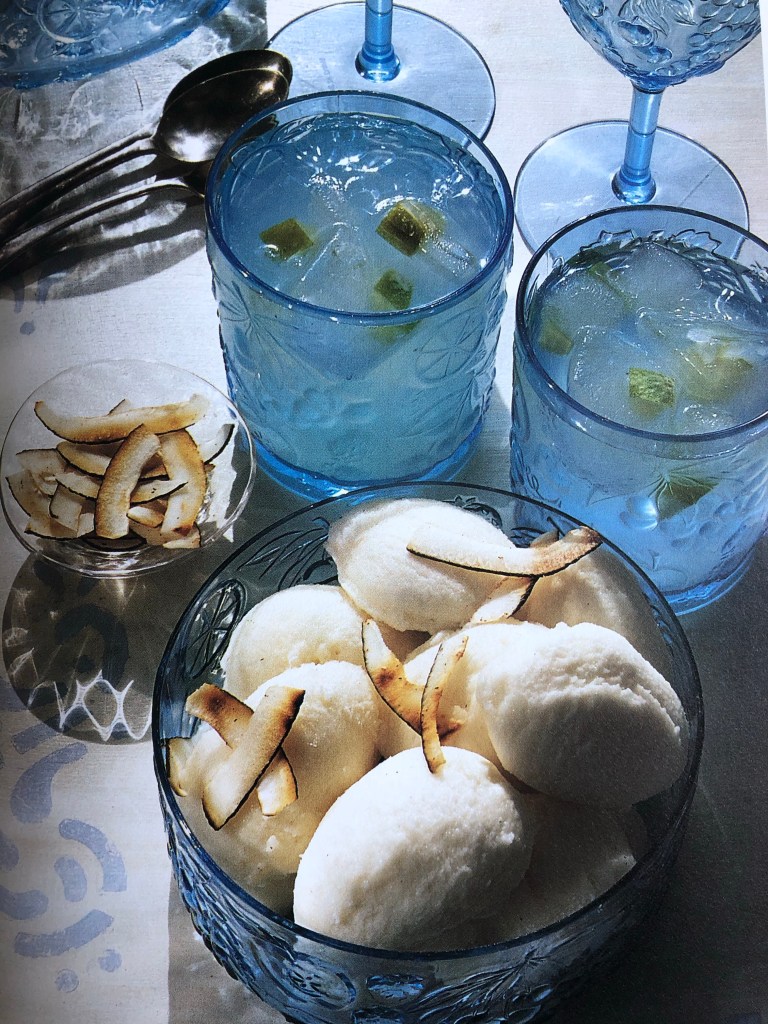
Photo by Michelle Garrett, food stylist Liz Trigg, from The Complete Caribbean Cookbook by Pamela Lalbachan

1 cup (8 fl oz/250ml) fresh coconut milk
1 cup (8 fl oz/250ml) fresh milk
3 tablespoons cornflour (cornstarch)
1 cup (8 fl oz/250ml) caster (superfine) sugar
1/4 teaspoon salt
2 tablespoons grated coconut
2 egg whites, beaten to soft peaks

.

  1. Combine coconut milk and halt the milk in a medium saucepan.
  2. Combine remaining milk and cornflour and add to the saucepan with the sugar and salt.
  3. Cook over a medium/low heat, stirring constantly, until the mixture forms a thick custard-like consistency.
  4. Stir in the grated coconut. Allow to cool.
  5. Pour the mixture into a lidded container, cover, and place in the freezer until it is partially frozen.
  6. Transfer the mixture to a large bowl, add the egg whites and beat until smooth. Return the ice-cream to the container and freeze for 3 hours, then beat again until smooth and creamy. (Alternatively, freeze in an ice-cream maker following the manufacturers instructions.) Return to the freezer until the ice-cream is frozen.

Serves 4

Working from home

Before the lockdown officially kicked in, many businesses and organisations were already acting on their better judgement by closing workplaces and considering how to keep staff safe, as well as how to transfer our work spaces to our homes. Trailing the forward thinking, the UK government focussed its entrepreneurial mind on how we would carry on our jobs, provide essential services and primarily, keep the economy ticking over, albeit in isolation. So, here we are, working from home.

For me, one plus to having work and home in the same place, apart from the obvious safety aspect, is that it has given me more control over cooking and eating routines. I can take later lunches and prep the evening meal earlier in the day or even the day before. Yet, despite the helpful time shifting, there is a sense of retrogression about lockdown. I’ve found myself reviewing times gone by, without romanticising, to a time when labour-intensive food preparations and preservations were intrinsically part of family and working life.

Home working these past few weeks also got me thinking to when I first came across working from home. I remember as a very young child, my Grandma worked as a dressmaker in our home. The days would begin and end with the humming of her sewing machine. A sound that filled the room with its undulating buzzing, controlled only by my Grandma’s slippered soles as they pressed down on the square pedal at her feet.  

My Grandma, a dressmaker, in her north London home in the 1960s.

As a child, I marvelled at the rainbow coloured, odd shaped cut-outs which were dropped off in the mornings in huge tied bundles of fabric, and later picked up as ready-to-wear and virtually ready-for-sale dresses. Getting the textile jigsaw pieces to fit together into a coherent wearable garment took her a lot of sewing hours. My Grandma worked hard back then, only stopping her work to prepare meals for the family. 

One dish I remember vividly that she used to make was spiced sautéed chick peas, known simply as channa in our house.  It was a quick snack she would put together using chick peas (soaked overnight) and ‘a good pinch’ of just a few spices, including jeera (cumin seeds), sautéed with chopped garlic and onions. She cooked it to texture and taste perfection, until the sweetness of the onions contrasted flawlessly with the nutty, buttery chickpea flavour. It was well-timed and a good stalling tactic for her ahead of preparing the evening meal later. Once she had bowled up the steaming channa, coated in roasted jeera, paprika and ground black pepper, she would get back to her sewing.  

Dried chick peas by Poet, Writer and Food Photographer, Adam Aitken, Australia

Like so many new migrants in the 50s and 60s she was a home worker and, like others at that time, she was subject to a hostile social environment in Britain. Work was available but the welcome, not so great. Indeed, it’s a well documented migrant story far and wide that a community’s response to their host’s hostility and accompanying discrimination, is to seal off and conserve cultural traditions; to build a safe haven where the heart and soul of their heritage can be protected.

Looking back, that response was echoed within our family and that of family friends. Over time, each of them built part of a nexus that together made up a whole community. Food, religion, literature, music and style were all constituent parts, which when strung together kept an impregnable lifeline to the Caribbean while guarding cultural keepsakes. It ran through our home and weaved, unfettered, through the homes of family, family friends and beyond. My Grandma’s cooking was just a part of that common thread.

In her north London Victorian terrace, her two worlds converged, creating a montage of cultures and a gateway, for me, to the Caribbean spirit. As a child, I was still to visit Guyana. Yet, growing up I could feel its character and its temperament: a gentle breeze swept through its scented mango and guava trees, a warm yellow light lit it up and blue skies held it all together on a wildly changing terrain. Feeding my imagination were the pictures that hung on the walls and mantle pieces, some boasting Guyana’s sunladen landscapes, others recounting history in black and white images. In contrast to the monochrome, displayed around the house was a show of Caribbean flora growing with the flamboyance of attentively nurtured fresh and artificial flowers.

Easily though, the kitchen was the most interesting, a place of curious things where my Grandma kept some unusual looking utensils. One that springs to mind was her dhal gutni. It had a wooden handle with an eight-pointed wooden star attached at one end. When the handle was swizzled between the palms, the star magically transformed cooked lentils into a smooth dhal. No electricity required.

Accordingly, her kitchen was a gastronomic hybrid of the offerings of both the tropical and temperate. On the one hand, she did her best to get hold of beloved ingredients like cassava and karela (bitter gourd), on the other, she embraced new foods like grapes, apples and cabbages. Make no mistake, we were privy to a range of amazing Dr Who-looking fruit and vegetables which were a far cry from the school dinners we ate at lunchtimes. As for chick peas, we only ever saw them at home, in my Grandma’s channa.

Somehow though, she brought it all together under one roof: tradition, home and her work. I suspect her work probably took over more than she wanted. Back then, dressmakers around the world, were not protected by labour laws and in many households similar to ours, once children returned home from school, they helped women meet their targets.  We too used to help my Grandma finish off. Using our plastic knitting needles, we turned the sewn edges of polka-dotted collars into sharp acute angles and matching dress belts, into perfect perpendicular corners.

Dressmaking was also immensely popular work among immigrants across the Atlantic where that same protection of community and culture built up around the tenements in lower Manhattan. While New York Italians were preserving the virtue of their pastas and pizzas, their fellow-German migrants were seasonally preserving cabbage in large barrels for sauerkraut. New York’s tenements in the 1800s through to the 1960s, housed many a dressmaker and provided hundreds of migrants with jobs. Around Elizabeth Street in old Little Italy, Italian women sewed at home for the garment industry and their children helped also with finishing work at home.

In truth, working from home is no newcomer, it’s a centuries-old way of working that’s been reinstated and reinvented by the Covid-19 crisis. One of the differences though, in it’s modern interpretation, is that it’s possible to take stock and, hopefully, improve work-life balance. For me, working at home has brought back the aroma of freshly roasted jeera drifting through my day. Weaving the thread from my London upbringing into my kitchen and very much shaping the fabric of my life. As dried chick peas fall into the bowl in their loud clamour, I’m reminded of the many dishes brought into my world from my Grandma’s past, a reminder of her life’s stories told. Of the place, throughout my life, I would always hear her call home.

..

Channa (sautéed chick peas)

Ingredients

200g dried channa (chick peas), soaked overnight in around 800ml cold water, or 1 can of channa, drained and rinsed under cold water
3 tablespoons sunflower or vegetable oil
1 medium onion, peeled and chopped
2 cloves of garlic, very finely chopped
1 red chilli, preferably a Scotch Bonnet*, finely chopped with seeds, (reduce amount or omit if you prefer less of a kick)
1/2 teaspoon ground paprika
1 teaspoon roasted jeera seeds (cumin seeds** or ground)
1/2 teaspoon freshly ground black pepper
salt to taste


* Scotch Bonnet pepper, a fiery and colourful Caribbean pepper with truly awesome flavour, once you get past the heat.
** If time allows, for a full cumin experience, dry roast the seeds in a small frying pan for a few minutes on a low-medium heat. Shake the pan regularly until the seeds turn a medium-dark brown and their aroma is released. Then use whole or partially crush in a mortar and pestle.

  1. If using canned, drain channa into a colander and rinse under cold water.
  2. If using soaked, place the channa with the soaking water in a medium sized pan. Set on a high heat and bring to the boil. Reduce the heat to a simmer and continue to cook for around 30-40 minutes until just soft to the bite. Drain the chick peas in a colander.
  3. Heat up the oil in a medium sized pan. Add the onions and sauté for around 6 minutes until the onions are translucent.
  4. Add the garlic and chilli and continue to sauté for 1 minute.
  5. Now add the channa and continue cooking for around 10 minutes, stirring regularly, until the onions are a golden colour.
  6. Add the spices and salt to taste and stir through. Cook for another minute. Taste and adjust, if necessary.
  7. Serve hot or cold.

Tip: When serving add a generous squeeze of lime juice and chopped coriander.

Serves 4 as a snack/appetiser/side dish

Going bananas

Lockdown has fast become a ‘normal’ way of living but that’s not to say that some days I don’t wake up feeling like the one thing I want to do is to go out. Instead, I accept that life has gone bananas, temporarily. That said, it does seem that lockdown has brought out the baker in many of us. YouTube clips and Instagram inspiration are kick-starting dormant bakers everywhere.

My neglected fruit took me on a welcome journey this week and got me baking banana bread. I pondered the countless ingredient additions there are to a banana bread recipe.

Thanks to the supermarkets, corner stores and food workers many of us are not short on choices of fruit. Thank you, again, key workers for maintaining a steady supply of bananas to our supermarkets and local shops during lockdown. My deep gratitude is extended to the long chain of workers required to bring bananas from their country of origin to our local streets at this difficult time.

Every time I make banana bread, I think of Dominica where I once tasted a banana bread so delicious that it’s never been forgotten. A bunch of characteristic Caribbean flavours that run through the islands were brought together in one sweet, moist banana bread.

Bananas are aplenty in the Caribbean; finger bananas, sugar bananas, Cavendish, red-skinned bananas and more. Each variety carries its own characteristic flavour and levels of natural sweetness.  So, for me, it’s no surprise that when I put ripe bananas, Demerara sugar*, nutmeg, cinnamon and allspice into a mixing bowl that I think of my Dominican banana bread. Actually, from these ingredients alone you get a compilation of island stories.

The Demerara sugar takes you to slave plantations and slave rebellions in the Demerara region of Guyana in the 1830s, (ok, it’s not an island). Nutmeg and cinnamon were among a collection of spices to name the island of Grenada ‘the Spice Island’ because of the world-leading levels of cinnamon, nutmeg, cloves and mace it produced. Allspice, loaded with regional revelations, leads you to the origins of the bbq where Jamaica’s indigenous people (the Taino) used the allspice berry branches to cook their meat. Indeed, the art of ‘jerk’ cooking emanates from the allspice berry lending itself to a cascade of recipe stories. As for the bananas, Day-O, Day-O, daylight come bringing many a song and story recounting a long history of banana labourers’ lives and fruit production in the West Indian economy that continues to the present day. And, if I were to add some rum to my mixing bowl, as I so often do, we’re in the territory of the world’s finest rums.

Bananas have been grown and exported from the Caribbean for centuries. They are an important part of the economies of many islands, such as the Dominican Republic and St Vincent. Once an important bread and butter industry, (no pun intended), bananas, along with sugar, kept the economies of the islands buoyant. Unfortunately, over the past decades, banana exports have massively declined, as large-scale production in other parts of the world has stifled the small family run farm and medium sized plantations in the wider Caribbean.

The Windward islands do still produce bananas only now on a much smaller scale. The politics of global economics has left the Caribbean banana industry suffering, despite the fact that the Caribbean, arguably perhaps, produces the most flavoursome bananas out there.

For me, the best bananas I have ever tasted were in the Caribbean. The region’s banana plantations struggle yet they manage to thrive, despite competition from mass production in other countries. Islands such as St Lucia and the Dominican Republic are assisted by Fairtrade so that they can continue to export bananas. I always seek these out when shopping because they tend to support the smaller producers in the Caribbean while also promoting the use of less chemicals. And, they taste good too!

Whatever bananas you chose, there’s no excuse not to make banana bread because we all, at some time, have overlooked bananas, forgotten as their hue drifts from sunshine yellow to deep brown. Well, most of us. As each day passes, they sit in the fruit bowl turning darker and darker while the sugar within reaches fermentation levels. At this point, you can either steal the moment, or you could forward plan and purposefully set aside some bananas to over-ripen for baking. The jury is still out as to whether you have to use seriously over-ripe blackened-skin bananas or just plain ripe bananas, but in my opinion over-ripened is good, it makes for a moist and flavoursome banana bread.

*origins of this variety of sugar is from the Demerara region of Guyana. A missed opportunity to give it a geographical indication of origin, perhaps, as many countries now produce demerara-style sugar, such as Mauritius.

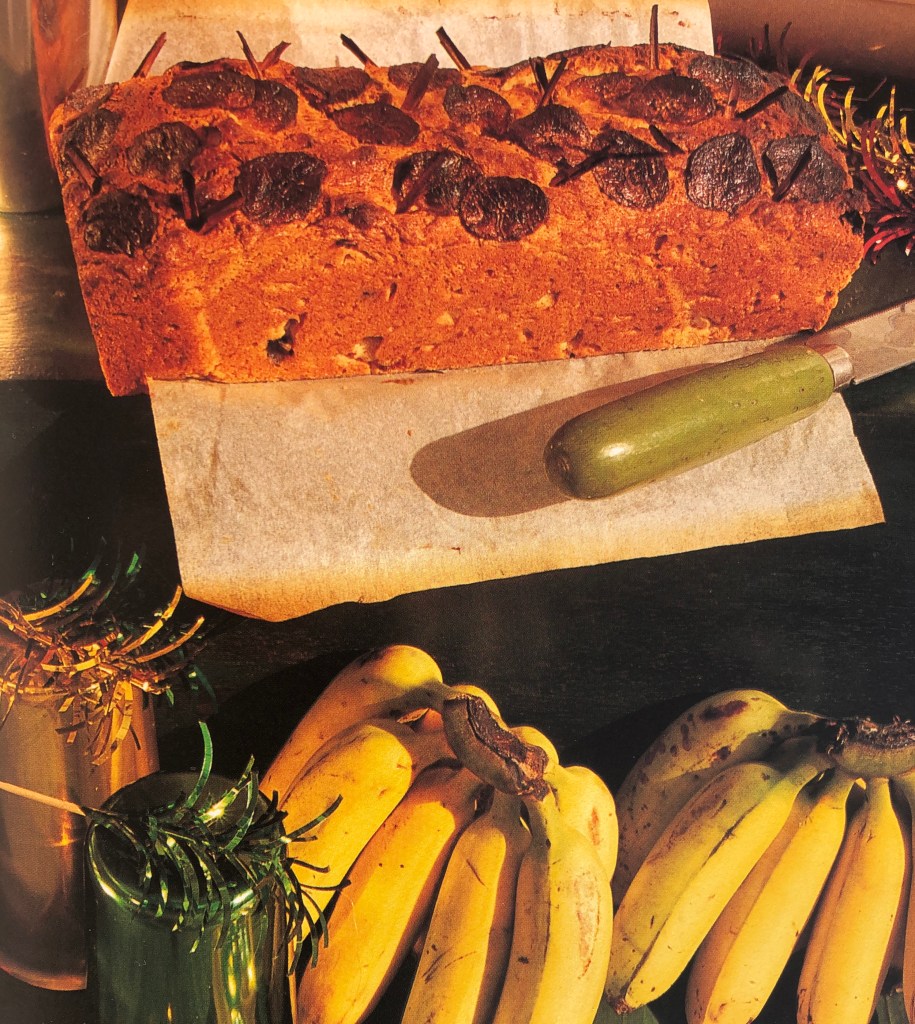
Banana Bread

Photo taken from my book, The Complete Caribbean Cookbook by Pamela Lalbachan, Lansdowne Publishing

I sometimes add to this recipe a tablespoon or two of golden or dark rum at the point that I add the milk. It adds a little something special.

.

8 oz(250g) butter
8oz (250g) demerara sugar
3 very ripe medium bananas, peeled and mashed
1 medium egg, beaten
1 lb (500g) self-raising flour (or plain/all-purpose flour + 1 tablespoon baking powder)
½ teaspoon ground cinnamon
½ teaspoon freshly grated nutmeg, or ground nutmeg
½ teaspoon ground allspice berries (if you do not have this you can omit)
½ cup of milk
1 teaspoon vanilla extract (vanilla essence is a good substitute)
1 tablespoon of dark/golden rum (optional)
1 tablespoon seedless raisins

.

  1. Preheat the oven to 350°F/180°C/Gas 4.

2. Butter a 9 x 5 inch (22.5cm x 12.5cm) loaf pan. 

3. Cream the butter and sugar together until light in colour.

4. Add the bananas and the egg and mix well.

5. Sift in the flour (and baking powder if using plain/all purpose flour), cinnamon, nutmeg and allspice and stir well into the mixture until combined. 

6. Add the vanilla extract to the milk and stir. Gradually beat in the vanilla-milk liquid, and rum (if adding). 

7. Stir in the raisins. 

8. Pour the mixture into the prepared pan and bake in the centre of the oven until a skewer inserted in the middle comes out clean, about 45 mins-1 hour.

9. Allow to cool in the pan for 10 minutes, then turn the bread out onto a rack to cool completely.

Makes one 9 x 5-inch (22.5 x 12.5cm) loaf