Today is National Windrush Day, a day to honour the British Caribbean community, who arrived between 1948 and 1971. My family are part of the generation of West Indians who came to Britain during that time, to help repair post-war Britain in the 1950s. So today, I’m taking a little time out to reflect on this day and on my family’s migration to the UK.
Having chosen to make London their new home in the 1950s, my grandparents anticipated a new and prosperous life in a land promising hope to generations. They set sail from Guyana’s tropical shores for London’s cooler climes. Their first cultural adjustment was the weather. Bitterly cold winters, with snow almost knee-deep in Finsbury Park had them questioning the joy and laughter promised to them on glittered Christmas cards. Winters in London turned my Grandma into an expert in layering and insulating the body, making us leave for school in Michelin-man style.
Naturally though, there were highs and lows to uprooting to a new country. The Windrush story can’t truly be told without acknowledging that racism hindered the ease within which the Caribbean community settled in. I know my grandfather regularly questioned why they had been allured to Britain, with its enticing advertising, when the reality was they were faced with barriers when trying to set up the most basic needs of a family, such as housing. Back then, it was standard to see signs displayed in windows saying ‘No Irish, no blacks, no dogs’.
The fight for equality and justice was always an undercurrent for the Windrush generations, and remains so. Yet, as I begin to surmise what it means to celebrate Windrush day, as a first-generation Guyanese, I think about the West Indian community as having intrinsically helped to shape what is British culture today.
Growing up in London, the Notting Hill Carnival was, for me, Windrush Day. The music, the smell of jerk chicken, sautéed plantain and saltfish, the taste of Guinness punch, and the colours, the lively shades of the islands. All of this was an emblematic celebration of the achievements of the diaspora. Sound systems stacked in the streets of Ladbroke Grove and Portobello Road, transformed west London into a Caribbean carnival for a whole day. People came together on a summer’s bank holiday with Soca, Chutney, Ragga, Reggae and Rap vibrating deep into the soul.
When I take carnival out of the experience, I see my family and community settling in a place that they were both shaping and confronting. I see also my grandmother, a strong woman, gathering strength and resilience along the way. She, like other West Indians, made and sustained a life in Britain, a good life at that. Once she had worked through the tangled turmoil of British society, with all of its contradictory standards, she had a happy life. She belonged to a community with shared experiences, and spent time with friends and family, who she cooked for and laughed with, and cried with too.
This Windrush day, I pay respect to the generations who paved the way for us, and made it easier for my generation. I also celebrate the Caribbean heritage kept alive through families, grandparents and great grandparents. Today, of all the wonderful places I have been fortunate to live in and visit, with all their beauty and serenity, my favourite place in the whole world to be was at my Grandma’s kitchen table. The brightly coloured floral tablecloth, her kitsch salt and pepper shakers and homemade chutney, all props for the centrepiece, her life’s stories in Guyana. After cooking and eating together, followed by a dessert always served with ice-cream or custard, the radio playing, we would sit there for hours, just limin’.
..
Coconut Ice Cream
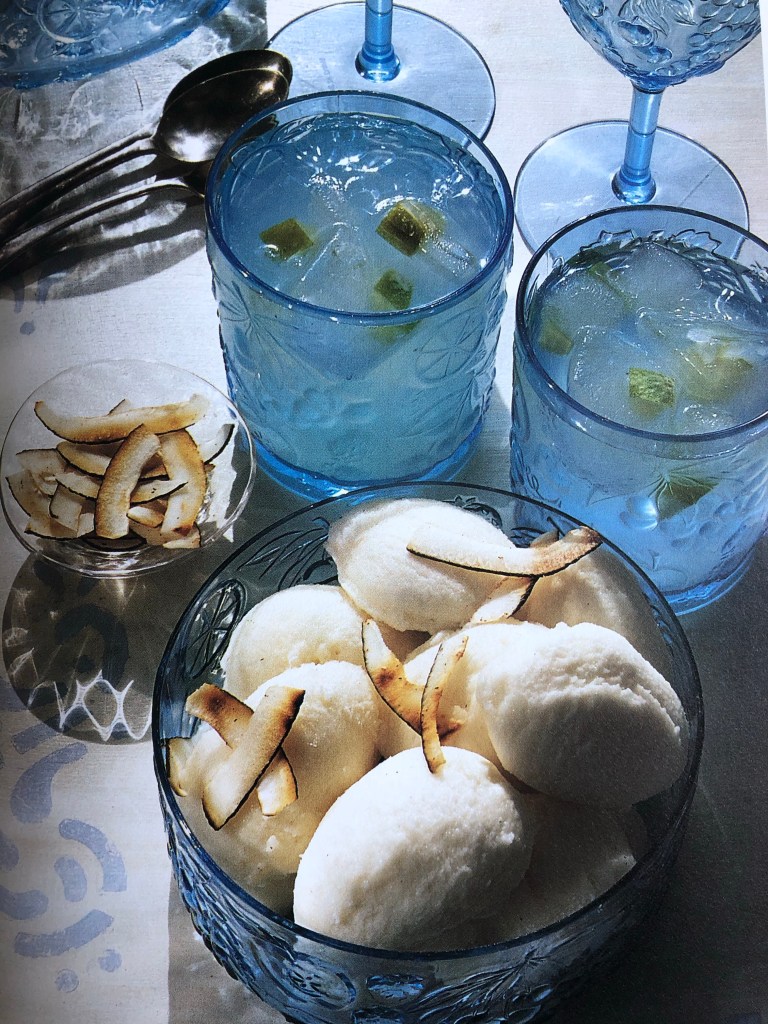
1 cup (8 fl oz/250ml) fresh coconut milk
1 cup (8 fl oz/250ml) fresh milk
3 tablespoons cornflour (cornstarch)
1 cup (8 fl oz/250ml) caster (superfine) sugar
1/4 teaspoon salt
2 tablespoons grated coconut
2 egg whites, beaten to soft peaks
.
- Combine coconut milk and halt the milk in a medium saucepan.
- Combine remaining milk and cornflour and add to the saucepan with the sugar and salt.
- Cook over a medium/low heat, stirring constantly, until the mixture forms a thick custard-like consistency.
- Stir in the grated coconut. Allow to cool.
- Pour the mixture into a lidded container, cover, and place in the freezer until it is partially frozen.
- Transfer the mixture to a large bowl, add the egg whites and beat until smooth. Return the ice-cream to the container and freeze for 3 hours, then beat again until smooth and creamy. (Alternatively, freeze in an ice-cream maker following the manufacturers instructions.) Return to the freezer until the ice-cream is frozen.
Serves 4


 Pamela Lalbachan