Yesterday, I decided to make a Cuban cerdo asado (known also as lechón asado outside of Cuba), roast pork. I was inspired by the fruit in my kitchen. Out of the corner of my eye, I caught bright limes blur into two bergamot lemons against fully ripened oranges. The collective zests reflecting a light only the impressionists know how to capture.
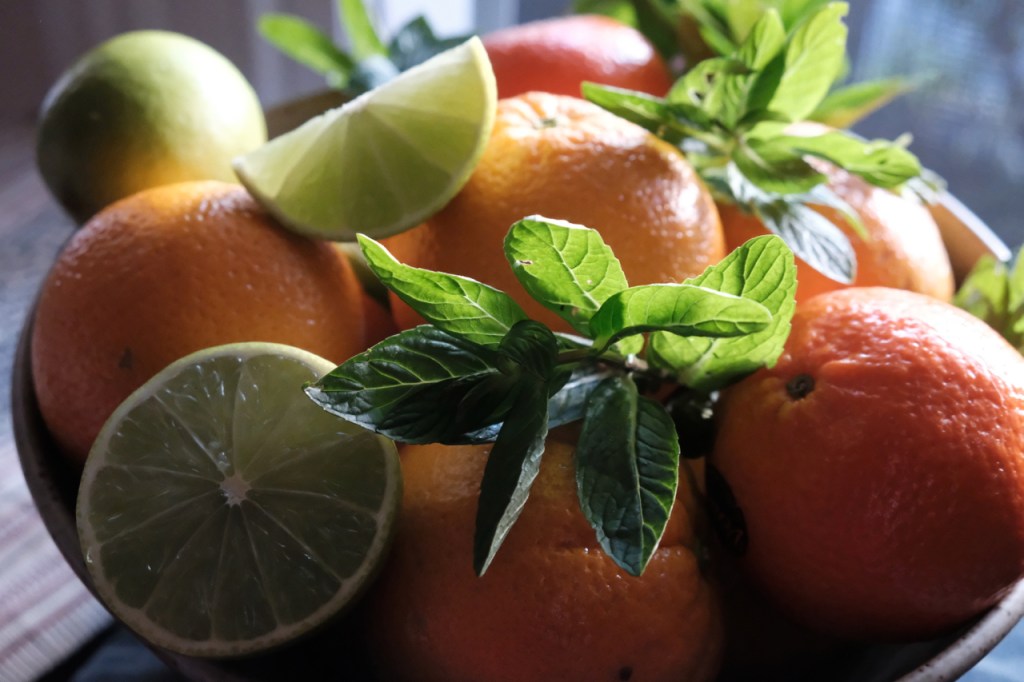
Their citrus allure led me to put together the marinade for the cerdo asado. Traditionally made with Seville oranges (bitter oranges), that I unfortunately cannot buy, I made do with combining lime and lemon juice to sweet orange. Once added to the pork, its best left refrigerated overnight, if time allows. I gathered the ingredients: fresh oregano from the garden (dried is also very good), garlic, my oranges, limes and a lemon, bay leaves and black pepper, and sometimes, I add a little cumin.
I am an aficionada of Cuban food which I note has been deconstructed and reconstructed over recent decades, often leaving the newcomer to Cuba wondering what all the fuss is about. It’s inevitable that some travellers may come away disheartened by their experience. Having had the gloss of intoxicating mojitos and the nostalgia of specialities like empanadas and tamales, promised in the travel branding but that fail to show.
The reality is, the visitor’s dining experience begins with a brutally cropped version of a traditional Carte du Jour. Cuban food at the present time is a shadow of its former selves and has been for some time. With long queues to get staples and a limited range of food choices, it’s not surprising that the visitor comes away without the full picture. Whether they chose the Nacional restaurant, looking over Havana’s Malecon, or dine in the cafes amid the contagious beats of Santiago de Cuba’s revered music scene, there is little choice. An abridged recurrence of ingredients read as a precis of a real Cuban menu.
Since achieving its acclaimed Revolution in 1959, Cubans have faced multiple setbacks to date. Hostilities and extended hardships have plagued post-revolution Cuba and its leadership. Marred by the fallout from capitalism’s continued hysterics, Cuba has had to curtail doing business with just a handful of trading partners. Families and cooks island-wide and across generations have suffered the consequences.
A fusillade of embargoes and economic blockades, isolationist policies, as well as the parting of ways with old aid and trading friends has been unrelenting for Cuba. Burdened by economic barriers and subject to skewed leadership, Cuban cooks have had to learn new ways of cooking traditional recipes and to make do with limited ingredients. The highs and lows of supply plot how Cuban cuisine has and is taking shape in a country where the land is fertile but resources are few.
In the current climate, the lows last longer, compounded by Venezuela’s crises as well as the impact of decisions made by a long time acquaintance. Segue to the current US leader. Executing his policies with buffalo-finesse, he has ordered a wind back to pre-Obama times in relation to Cuba. The progress the Obama administration made in resuming diplomatic ties, allowing Cuba to export its world-renowned rums and cigars, has been reversed and old restrictions have returned.
Cuba is back to dealing with a vengeful neighbour who has packed up his toys and taken them home, again. With Monopoly-mentality, he has withdrawn the Marriott hotel and ceased play. By contrast, it comes as no surprise that a country whose people have repeatedly garnered the will, expertise and determination to take on their imperialist ex-friend, has impressive control of Covid-19. If only they had exchanged notes. Cuba could have shown the US how they prepared two months prior to their first detected case, how they actively screen, and how their very strong primary healthcare system has been a major factor in controlling their outbreak. But still, the US has Cuba to thank for the dazzling Cuban fare found on its soil.
Following the Revolution, the secrets to Cuba’s deep-rooted culinary traditions were smuggled out. Stuffed into bourgeois suitcases packed last minute, they were carried in boats pulled in by Florida’s tow ropes. Drawn to the attraction of surplus and their host’s open-arms reception, a welcome preserved only for defectors, the migrants unloaded and assimilated into American life.
Taking their first step onto western democratic soil, and at ease with the entrepreneurial spirit that made America great, they set about realising a profit from their recipes and knowhow, among other things. So began the wave of predominantly middle-class Cubans into the US, who had shirked the Revolution. Most diffused into the long-time established Cubana community in Miami; made up of tobacco factory labourers, artisans and contract farm workers.
Miami’s Little Havana, had been first populated and built by economic migrants. They were fleeing poverty long before the revolution, and during the time when rich Americans traded their meagre dollars for Cuban souls. The area was later expanded by counter revolutionaries. Setting up their homes, cafes and restaurants in and around the area, the newcomers commemorated their new life with culinary invention: Miami’s infamous Cuban Sandwich. A testimony to their exodus.
Little Havana lays just a few sailing hours away from the mother country, where cooks continue to adapt or create recipes in their sparse kitchens. Surrounding the streets around Calle Ocho, bustling bars and eateries trade in stark juxtaposition to the scant restaurants across the straits in Santiago de Cuba, Varadero and Havana, Cuba’s tourist hot spots.
It was in Little Havana, that I found signature dishes like ropa vieja and picadillo that were either completely absent in Cuba or adapted to availability. Here staff served in restaurants decked out like ‘home’ and decorated in colourful artwork. I found a fantastic cafe, where Cuban son dropped infectious latin beats while customers perused an impressive menu. Steaks were served with the ubiquitous mojo criollo (fresh garlic sauce). Seafood such as lobster was in abundance, lechón asado was served with sliced yuca, sautéed plantains and a rich recipe of frijoles negros (black beans) or, the historically named, moros y cristianos (black beans and rice, or Moors and Christians).
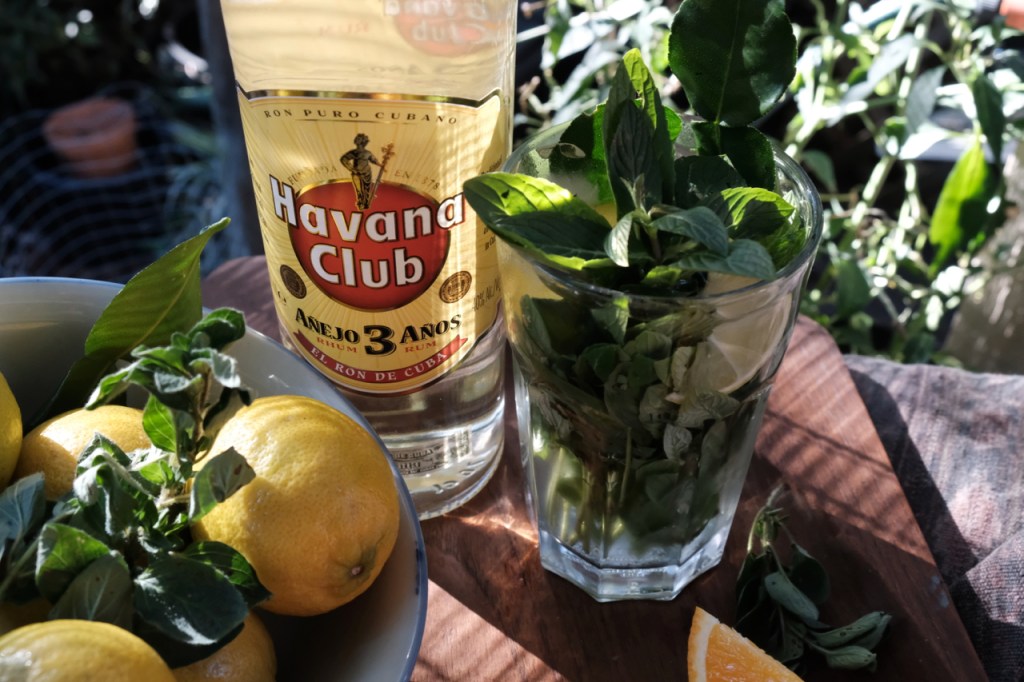
Back in Havana, I had found that some old classics remained largely intact. But they were mostly in the honoured restaurants of Hemingway’s choice, La Bodeguita del Medio and El Floridita. Among the few recipes that remained true to their origins, were the cocktails and drinks. In El Floridita, I had a beautiful margarita in 1950’s style. In the Nacional bar, I sipped on Cuba Libres with fresh limes slices afloat. Not to be missed was the fresh yerbabuena (Cuban mint) crushed in cane juice, doused in a sea of golden Cuban rum, topped in a highball with soda water and slices of lime. The Mojito. The fragrance of yerbabuena against the rum’s heady molasses is sheer genius in a glass.
Photograph by Adam Aitken 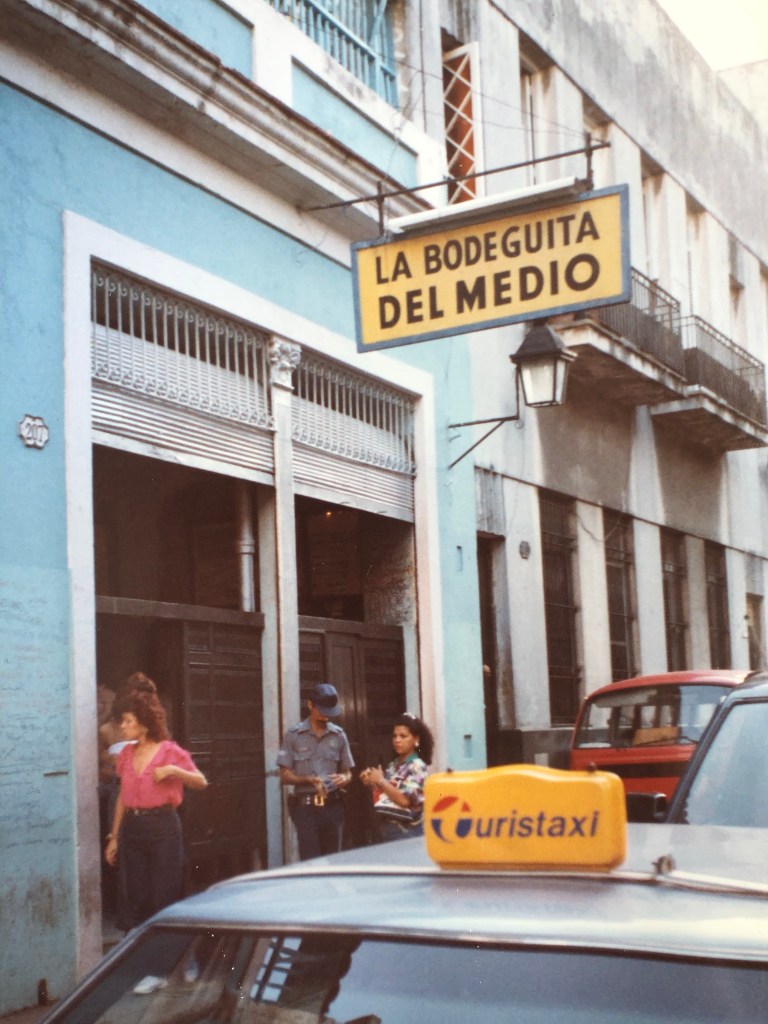
Photograph by Pamela Lalbachan
The afficionadas among us, rate Cuban food highly, both outside as well in, despite the shortages. On a visit to Havana, I was fortunate to meet a local cook and abuela (grandma), Angélica Suarez. She showed me just how good the food is, still. She had been cooking traditional Cuban food long before the Revolution. In her Havana apartment, she was holding together childhood traditions while successfully creating minimalist versions of old recipes where ingredients were scarce.
Angélica showed me how to make her unforgettable sopa de pollo (Chicken Soup). She also taught me how to begin the dish with a sofrito. From her, I learned that adobe (seasoning), an inherent component of meat and fish cookery in Cuba, mirrors the method of Guyanese home-cooking I was taught. Indeed, seasoning (or marinating), is a widely used precursor to preparing meat and seafood dishes in the whole of the Caribbean. Angélica seasoned her chicken with an adobe made of crushed garlic, oregano, paprika, olive oil and salt and black pepper.
The Cuban sofrito is also very similar to that of many Caribbean recipes, with the exception of the herbs used. Mediterranean herbs and ingredients are characteristic of a Cuban sofrito. Chopped onions, spring (green) onions, garlic, tomatoes, peppers, oregano, parsley, bay leaves and variations thereof make up a sofrito. The chicken pieces were cooked gently in its adobe, the sofrito and stock. Angélica later adds plantains, sweet potatoes, carrots and noodles to complete the sopa de pollo. The result was a wonderful, heart-warming dish executed with technique and steeped in layers of flavours.
I later went on to discover lechón asado in a paladar, a small in-home restaurant, in Havana’s backstreets. We found the place on a narrow residential street where we were beckoned by a couple to go inside. They welcomed us from their doorstep, as though we were personal guests. We were promptly directed to sit in the front room at one of two small round tables covered in red and white gingham tablecloths.
The hosts were the cooks, a content couple in their thirties, who were earning a living from tourism. They served us a lesser version of lechón asado, which is traditionally made with a suckling pig, on a bed of arroz con frijoles negros (rice and black beans) with yellow plantain slices. The strength of the characteristic bitter orange seasoning had been toned down, yet the pork was roasted to texture perfection and suffused with a robust mojo criollo.
The host told us that Cuba had known better times, and not that long ago either. She went on to talk about how she usually made her lechón asado, that is when ingredients are aplenty. It was a fascinating snapshot of criolla cooking, the triangular meeting point for Mediterranean citrus and herbs and an Afro-Cuban style of cooking meat with indigenous food. The addition of black peppercorns and cumin seeds completes the history; spices brought to Cuba by Iberian conquistadors via traders.
Although it was not easy to come by old traditional recipes in Cuba’s cafes and restaurants, I was impressed by the food I had eaten. It epitomised the place in time and the passion people have for their cultural identity. In everything I tried, whether it was a cocktail, contrived in part at least for the tourist, or a homemade meal, I experienced a strong and proud sense of Cuba’s culinary and national heritage. When economic burdens lift, Cuban chefs are doing what chefs do everywhere, taking in global trends and influences while preserving their traditional cocina criolla.
Cerdo Asado (Roasted Pork)
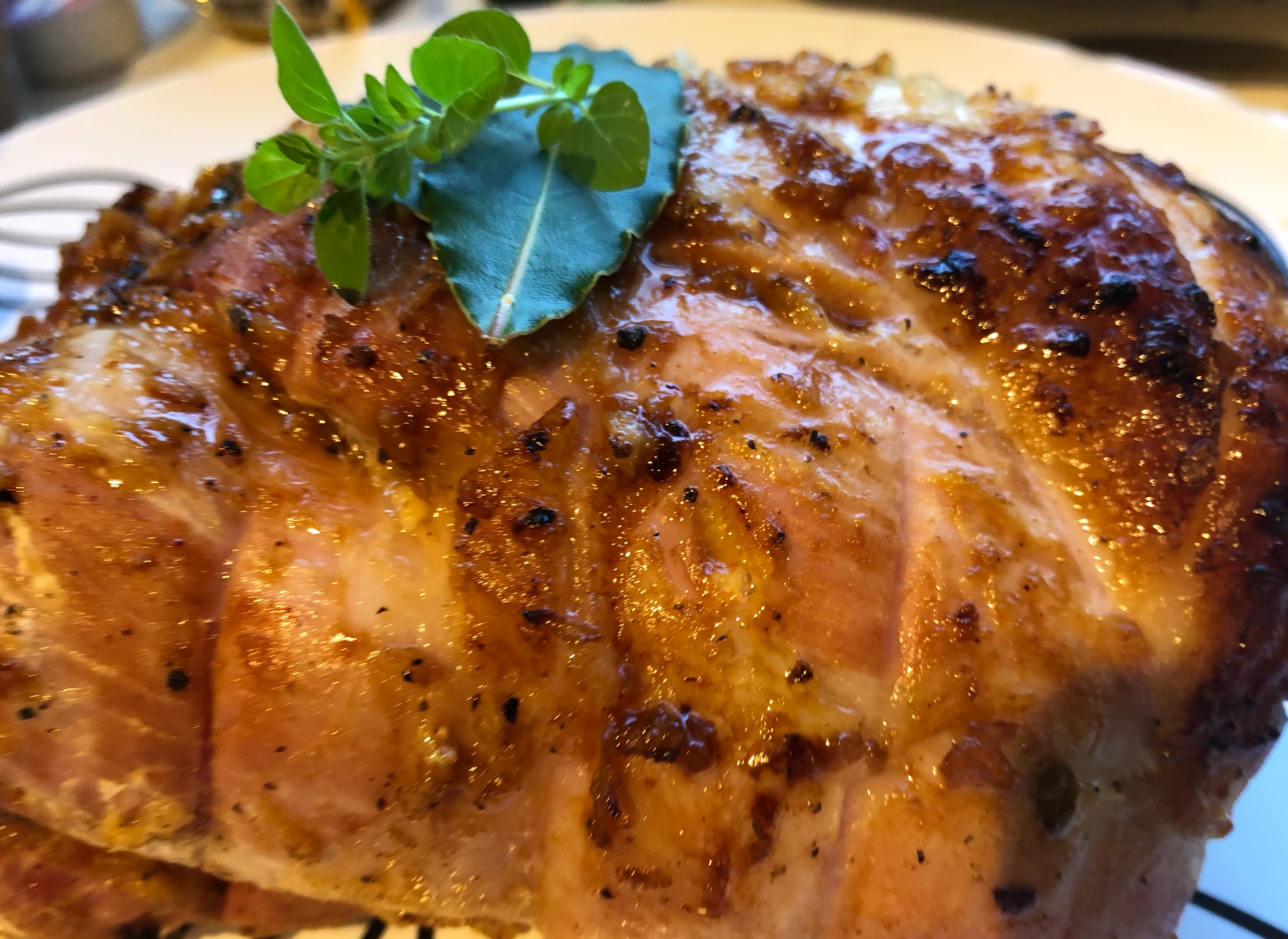
6 lb fresh unsmoked gammon or pork shoulder
8 cloves garlic
2 teaspoons salt
1 teaspoon whole or freshly ground black peppercorns, (or ground black pepper is fine)
1 and ½ cups bitter orange juice* (If you can’t get bitter orange juice, use one cup of sweet orange, ¼ cup lemon and ¼ cup lime)
2 teaspoons fresh oregano leaves or 1 teaspoon dried oregano
2 bay leaves, roughly broken
½ teaspoon ground cumin
1 and ½ cups olive oil
*bitter orange juice comes from Seville oranges. If you cannot get bitter (or sour) oranges substitute half of the sweet orange juice, mixed with one quarter fresh lime juice and one quarter of fresh lemon juice.
- Wash the pork and pat to dry. Pierce deeply around the pork with a sharp knife. Place in a lidded bowl or container.
- In a mortar and pestle, crush the garlic with the salt and peppercorns (if using whole peppercorns) until it becomes a paste. If using ground black pepper, add now and stir.
- Take half the garlic paste mixture and rub all over the pork.
- Transfer the remaining garlic paste to a small mixing bowl and add the bay leaves, cumin, olive oil and citrus juices to make the marinade.
- Pour the marinade over the pork and marinate in the fridge, preferably overnight. Rotate the pork or turn the lidded container upside down at regular intervals to ensure all of the meat is evenly marinated.
- Remove meat from the fridge around an hour before roasting.
- Pre-heat the oven at gas 3/170oC/325OF
- Place the pork in a non-reactive roasting pan, fat-side up and cover loosely with aluminium foil. Set aside the marinade. Cook for around 3 hours, (until the internal temperature reaches 170oF).
- While cooking, frequently spoon the reserved marinade over the pork and baste with pan juices.
- Remove foil and continue to cook for 2-3 hours, until the pork is soft. Baste pork in pan juices.
- Remove from oven, cover with foil and allow to rest for 10 minutes before serving. Serve with mojo criollo (garlic sauce).
Serves 6-8
Serve with black beans and rice, sautéed yellow plantains (for recipes see The Complete Caribbean Cookbook for recipe). To make the famous Cuban Sandwich use roasted pork slices.

Mojo Criollo
6-8 cloves garlic
½ teaspoon salt
1 small onion, very thinly sliced
½ cup bitter (Seville) orange juice* (see above)
¾ cup olive oil
- In a mortar and pestle or using the back of a knife, crush the garlic with the salt until it becomes a paste.
- Transfer to a small mixing bowl and combine onion and citrus juices. Allow to infuse for around 30 minutes.
- In a small pan, heat the oil until just hot, not smoking.
- Take off the heat and pour over the garlic mixture while stirring briskly.
- Serve with credo or lechón asado (roasted pork).
Makes around 1 cup
Variations: finish with ¼ teaspoon freshly ground black pepper and/or ¼ teaspoon dried oregano.
 Pamela Lalbachan