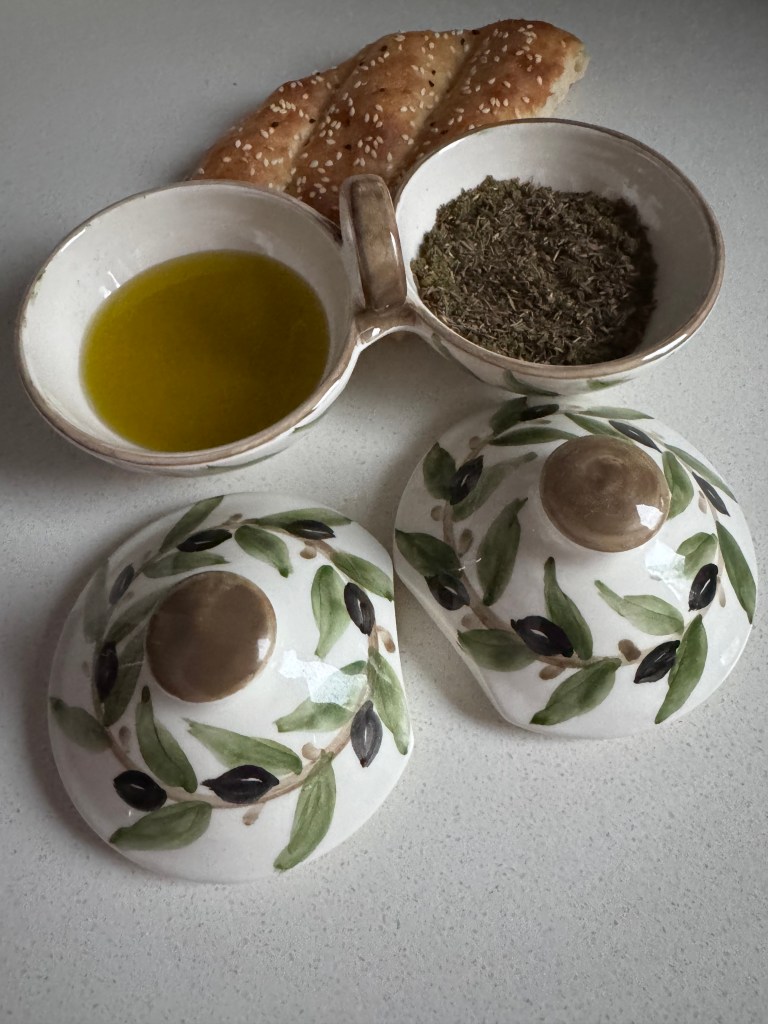
I was gifted a beautiful hand-painted ceramic zeit and za’atar dish this past Christmas, crafted in a woman-run artisanal workshop in Nablus, it feels very special on many fronts. It serves as a side by side home for olive oil (zeit) and a herb blend (za’atar). The adjoining bowls house a natural pairing of olive oil, usually extra virgin with its smooth peppery piquancy, and a blend of regional herbs (za’tar) often brought together on a fresh flatbread.
For me, it also serves as symbolic of the fertile and prospering lands of Palestine and the wider Middle East extending to the Mediterranean. Palestine, West Bank specifically, the origin of this olive-leaf painted dish is known for its abundance and famous for its olives and olive oil, yielding a rich and intense earth-green elixir of renowned quality.
Za’atar is a blend of herbs made up of dried oregano, wild thyme, marjoram, sumac, sesame seeds and salt, although recipes vary around the Middle East and Mediterranean. The combination of ingredients that make up za’atar balance woody, fragrant, tangy having its origins in Levantine culture from around the 12th century. Some histories date its origins back to what was Palestine and others to the Ancient Egyptians.
The zeit is usually an extra virgin olive and pairs perfectly with the za’atar, forming an inseparable unity carrying a spectrum of flavours in a bouquet of herbs along with a distinctive nutty smoothness in the sesame seeds. Zeit and za’atar form a perfect trinity when served with the freshly baked flatbreads of the region or on salads such as fattoush (an unforgettable ensemble of fresh green salad leaves and herbs, onions, tomatoes, cucumber, pomegranate seeds and molasses, sumac and stale bread with recipes varying around the region).
These flavours of zeit and za’atar and more became embedded in my memory as a teenager in the colourful balloning-fabric adorned ceilings of the Lebanese restaurants in Surry Hills, Sydney. Cleveland Street was, and still is, a little Lebanon food central. I used to think, when I entered Emad’s restaurant, I had left behind Sydney and walked into Beirut with the welcoming soft seating and low tables, designed for sharing with others.
For me, the zeit and za’atar bowl with both its purpose and aesthetic symbolises the fruitfulness and fertility of the region’s land and the unbreakable togetherness of family and home when sharing the spoils of that land, even through the darkness.
With hope that peace allows for the olive groves of Palestine to replenish and the family of herbs return in their plenty to be shared among the many.
 Pamela Lalbachan