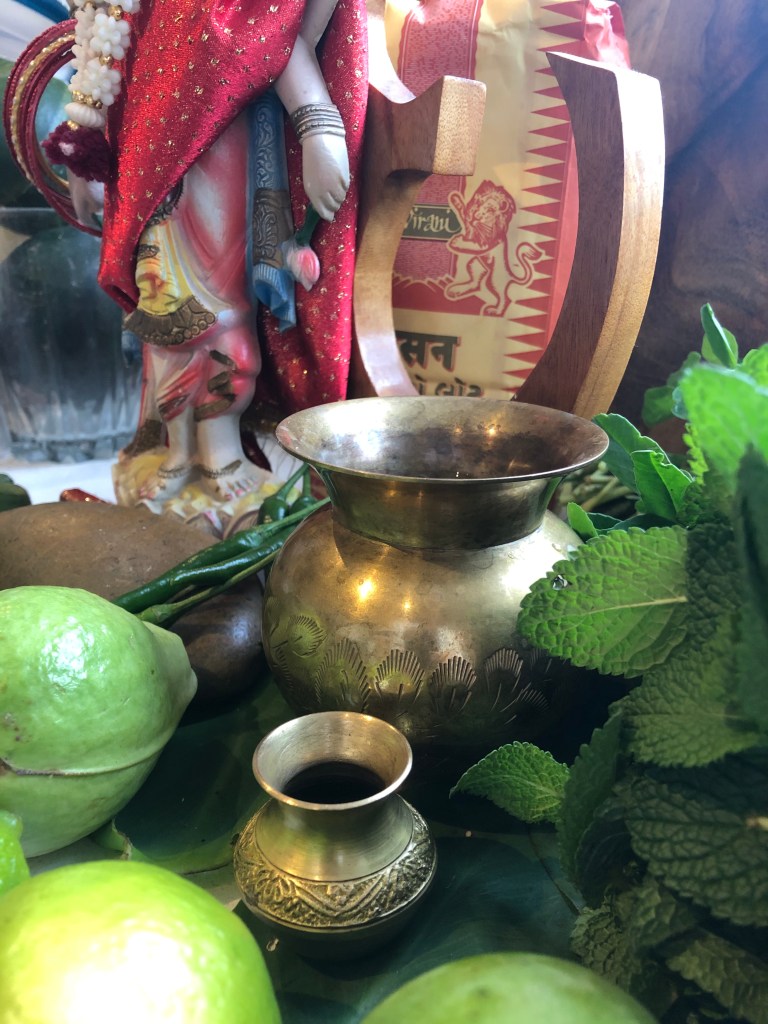
Lakshmi travels well

Indian Sweets By Adam Aitken, poet, writer and food photographer, Australia

Certain emotions bridge the years and link unlikely places.” V S Naipaul, Trinidadian writer


I started writing this blog, inspired by Diwali and the food and warm feeling I associate with it. Although it is a Hindu Festival, it is not the religious aspect in particular that I feel connected to, rather it is a sense of heritage and identity that move me. Lakshmi, who is honoured by Diwali, sat among the revered murtis (statue of a deity) in my Grandma’s living room, and together, the two of them made Diwali a lasting family tradition. They created a sense of belonging and hope when Diwali-time came around, which I have kept and carry with me. 

According to the Times of India, Indians make up the largest population living outside their country of birth. It‘s no surprise when you look at the back story that there are now around 18 million migrants living abroad. The expansion of the British Empire, as well as that of its European imperialist cousins’, resulted in the making of one of the world’s significant Diasporas.  Together, and often in agreement, they transported thousands of Indian labourers to the Caribbean, Africa and parts of the South Pacific and South Asia from 1830s to 1920s. It is through these ancestors that Indian religions, customs and beliefs have sustained, and sometimes, evolved outside of India. 

The popularisation of many religious events and festivals around the world, has put Diwali, among other celebrations, on the international calendar. Around this time of year, Indian recipes and ingredients appear in the supermarkets’ glossy magazine specials and television food shows are brimming with Indian cooking content. Long-time chef, Mary Berry, widely renowned for her British baking and cooking, recently departed from her regular format to visit a London-based family celebrating Diwali in her current television series. 

In spite of an increased market culture of commercialisation and promotion, it is the Disapora’s deep rooted affinity with Mother India that its descendants have honoured and conserved. Through the generations, the Diaspora has cultivated an unbreakable sense of self which I see in Indian families and communities. I learnt of it too, in a subtle philosophy that infused my childhood with the small things in daily life and beliefs and thoughts that belong to an Indian-ness.  While Guyana was the place we as a family were from, I understood that so too are we from India. It was this duality that, universally, older generations had to reconcile.  Now, generations on, add in another migrant journey and I am also a Londoner. 

In lockdown-London, for this year’s Diwali I was a bit ambitious. I’d made a trip to my favourite supermarket with a long list of dishes in mind that I had planned to prepare. I bought ingredients you would undoubtedly expect for the occasion: fresh coriander and fenugreek, garlic, ginger and turmeric roots, ghee (clarified butter), besan (ground chick-pea flour), okra, potatoes, aubergine and more. But I also made sure to get some pumpkin, guavas and scotch bonnets because the Guyanese, and in fact, the Trinidadians and Surinamese version of Diwali has a distinctive Caribbean lilt.

..

Fresh turmeric, ginger, green chilies, okra, mangoes, guavas, limes and fenugreek leaves.
Fresh mint, green mangoes and guavas.


Jaggery (cane juice slab), golden sultanas, cloves and cardamom pods. Ingredients for the popular sweet, parasad.

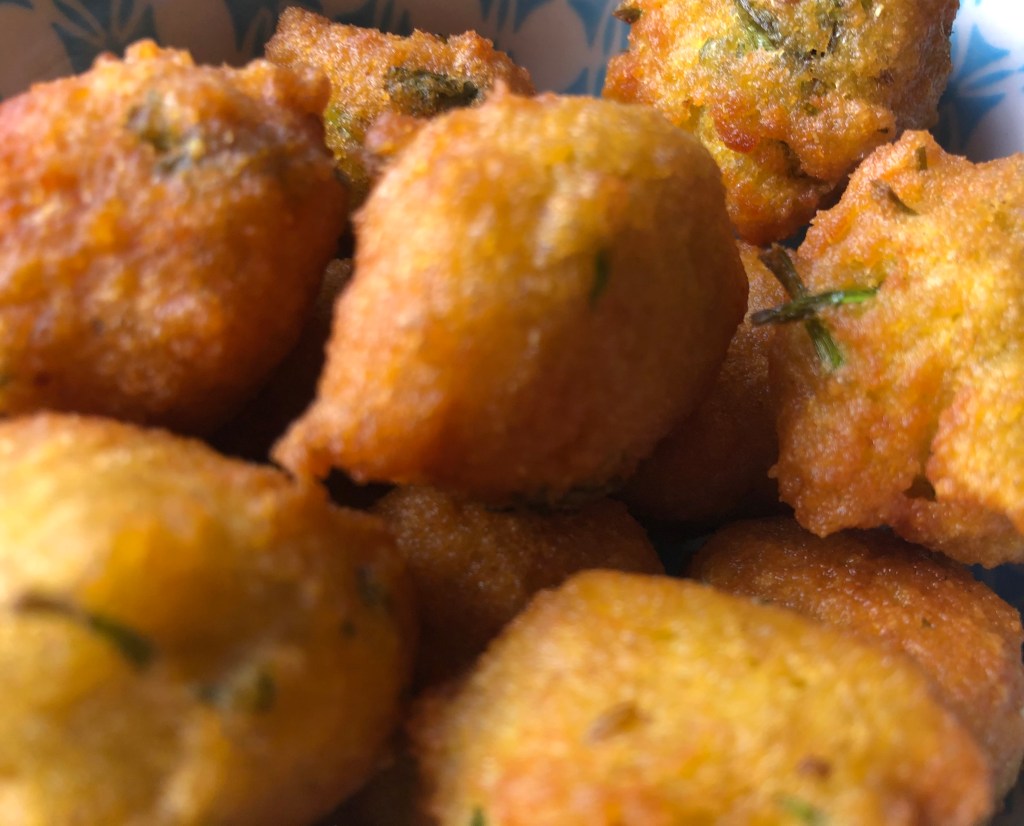
I had planned to make a green mango chutney to go with poulouris (spiced yellow split pea batter with spring onions and deep fried into balls), unmistakably an Indian-derivative street snack and found only in the Caribbean, as with dhal puri (a roti filled with spiced ground yellow split peas) and baiganee (aubergine slices deep-fried in a spiced batter).

Despite having helpers, I never got to the mango chutney or the baiganee. By the finish though, I had managed something of a feast. The dining table was graced with dishes and sweets from Guyana having made their way there from India many moons earlier, and somewhere in there was probably a little London-ness too. 

Below, is my offering to you: two favourite recipes that always appear in the family Diwali feast. I hope you enjoy them, all year round.

..

Pholourie (spiced yellow split pea balls)
.

½ cup yellow-split peas, soaked in cold water for around 4-5 hours
½ cup plain (all-purpose) flour
1 teaspoon of bicarbonate of soda or baking powder
2 cloves garlic, peeled
½ teaspoon ground turmeric
½ teaspoon ground roasted cumin seeds
½ teaspoon garam masala
¼ teaspoon freshly ground black pepper
1 teaspoon of salt or to taste
3 spring onions, green parts only, finely chopped
1 red hot chilli, finely chopped, optional
vegetable oil such as sunflower, for deep frying

  1. Drain the split peas, reserving about ½ cup of the water. 
  2. Put the split peas, ¼ cup of the water and garlic into a blender and process until a thick batter. Add more of the water if, necessary, in order to obtain a thick batter. 
  3. Using a wooden spoon, stir in the dry ingredients until well combined.
  4. Stir through the spring onions and chilli, if using. 
  5. Taste a small amount of the batter and adjust seasoning, if needed. 
  6. In a wok or heavy-based pan, heat the oil until hot. The oil needs to be hot, before smoking point is ideal.
  7. Once you have the oil at the right temperature, you can begin to cook the pholouries. 
    Forming the pholouries:
    By hand: using your fingertips and thumb, scoop up a portion of the batter.  Using your thumb to swiftly transfer the mixture, lower it gently into the hot oil. The pholouries should float to the top immediately, this indicates that the oil is hot enough.  Allow the pholouries to cook until golden, turning with a slotted spoon so that they colour evenly.  
    Alternatively, you can use two spoons to drop the batter into the hot oil. With one spoon, take a spoonful of batter and lower the batter gently into the hot oil using the other spoon to slide it off.
  8. Drain on paper towels. Continue to cook in batches.
  9. Serve with a green mango or tamarind chutney or a good Caribbean hot pepper sauce.

Serves 4-6 as a snack

..

Pumpkin Curry

3 tablespoons vegetable oil, such as sunflower
1 medium brown onion, peeled and finely chopped
2 cloves garlic, minced
1 green chilli, (or a banana chili or scotch bonnet), finely chopped, optional
½ teaspoon ground turmeric
½ teaspoon ground cumin
½ teaspoon garam masala
¼ teaspoon freshly ground black pepper
1lb (500g) pumpkin (or butternut squash) peeled, seeded and cubed
around ¼ cup water
salt to taste

  1. Heat the oil in a lidded karahi or heavy-based medium sized saucepan.
  2. Add the onions and allow to cook on a low heat for around 10 minutes, stirring occasionally until they are a deep golden colour. 
  3. Add the garlic and chilli and cook for around 1-2 minutes, stirring regularly. 
  4. Add the spices and cook for around 5 minutes, stirring occasionally to prevent the spices from sticking and burning. 
  5. Add the pumpkin cubes and coat well in the spice mixture by stirring through. 
  6. Add the water and stir.  Cook with the lid on for around 20-30 minutes or until the pumpkin is very soft. Once soft, break up pieces using the back of a wooden spoon so that the pumpkin is mostly mashed.
  7. Serve with rice, paratha rotis or puris. Dhal also makes a good accompaniment.

Serves 4

..

From Letter to Marco Polo by Adam Aitken, Australia

MENU
Beef curry & Chicken curry & chutney
& dhal last night, tonight vegetable
curry & leftover Port Vindaloo with
cucumber & yoghurt as a
                                                 side dish,
Was it like this in Mountbatten's time - 
this anglo-Indian post-coital bliss??
Consider Newtown's very own Swami's motto:
"My cooking is the result of
Indian tradition & personal genius & charm"
(I misquote grossly but the sense is close.)
What better way to sniff fire
after a bad flu or too much Virginia Woolf
serialised on 2FC.    When Percival goes to 
                        INDIA
everyone gets pissed on nostalgia 
after bubbly & smoked salmon & 
sleeps with everyone else.    Dipti
(who's got a thrilling past in the
crazy Ceylon corridors of power) thinks
it's overdramatised.   When her Mum brings
a Red Cross parcel of  CURRY  &
a bottle of Rose Syrup we dream of
climbing Everest  /  flying high on
Hilary's vision of India, now going nuclear. 


Working from home

Before the lockdown officially kicked in, many businesses and organisations were already acting on their better judgement by closing workplaces and considering how to keep staff safe, as well as how to transfer our work spaces to our homes. Trailing the forward thinking, the UK government focussed its entrepreneurial mind on how we would carry on our jobs, provide essential services and primarily, keep the economy ticking over, albeit in isolation. So, here we are, working from home.

For me, one plus to having work and home in the same place, apart from the obvious safety aspect, is that it has given me more control over cooking and eating routines. I can take later lunches and prep the evening meal earlier in the day or even the day before. Yet, despite the helpful time shifting, there is a sense of retrogression about lockdown. I’ve found myself reviewing times gone by, without romanticising, to a time when labour-intensive food preparations and preservations were intrinsically part of family and working life.

Home working these past few weeks also got me thinking to when I first came across working from home. I remember as a very young child, my Grandma worked as a dressmaker in our home. The days would begin and end with the humming of her sewing machine. A sound that filled the room with its undulating buzzing, controlled only by my Grandma’s slippered soles as they pressed down on the square pedal at her feet.  

My Grandma, a dressmaker, in her north London home in the 1960s.

As a child, I marvelled at the rainbow coloured, odd shaped cut-outs which were dropped off in the mornings in huge tied bundles of fabric, and later picked up as ready-to-wear and virtually ready-for-sale dresses. Getting the textile jigsaw pieces to fit together into a coherent wearable garment took her a lot of sewing hours. My Grandma worked hard back then, only stopping her work to prepare meals for the family. 

One dish I remember vividly that she used to make was spiced sautéed chick peas, known simply as channa in our house.  It was a quick snack she would put together using chick peas (soaked overnight) and ‘a good pinch’ of just a few spices, including jeera (cumin seeds), sautéed with chopped garlic and onions. She cooked it to texture and taste perfection, until the sweetness of the onions contrasted flawlessly with the nutty, buttery chickpea flavour. It was well-timed and a good stalling tactic for her ahead of preparing the evening meal later. Once she had bowled up the steaming channa, coated in roasted jeera, paprika and ground black pepper, she would get back to her sewing.  

Dried chick peas by Poet, Writer and Food Photographer, Adam Aitken, Australia

Like so many new migrants in the 50s and 60s she was a home worker and, like others at that time, she was subject to a hostile social environment in Britain. Work was available but the welcome, not so great. Indeed, it’s a well documented migrant story far and wide that a community’s response to their host’s hostility and accompanying discrimination, is to seal off and conserve cultural traditions; to build a safe haven where the heart and soul of their heritage can be protected.

Looking back, that response was echoed within our family and that of family friends. Over time, each of them built part of a nexus that together made up a whole community. Food, religion, literature, music and style were all constituent parts, which when strung together kept an impregnable lifeline to the Caribbean while guarding cultural keepsakes. It ran through our home and weaved, unfettered, through the homes of family, family friends and beyond. My Grandma’s cooking was just a part of that common thread.

In her north London Victorian terrace, her two worlds converged, creating a montage of cultures and a gateway, for me, to the Caribbean spirit. As a child, I was still to visit Guyana. Yet, growing up I could feel its character and its temperament: a gentle breeze swept through its scented mango and guava trees, a warm yellow light lit it up and blue skies held it all together on a wildly changing terrain. Feeding my imagination were the pictures that hung on the walls and mantle pieces, some boasting Guyana’s sunladen landscapes, others recounting history in black and white images. In contrast to the monochrome, displayed around the house was a show of Caribbean flora growing with the flamboyance of attentively nurtured fresh and artificial flowers.

Easily though, the kitchen was the most interesting, a place of curious things where my Grandma kept some unusual looking utensils. One that springs to mind was her dhal gutni. It had a wooden handle with an eight-pointed wooden star attached at one end. When the handle was swizzled between the palms, the star magically transformed cooked lentils into a smooth dhal. No electricity required.

Accordingly, her kitchen was a gastronomic hybrid of the offerings of both the tropical and temperate. On the one hand, she did her best to get hold of beloved ingredients like cassava and karela (bitter gourd), on the other, she embraced new foods like grapes, apples and cabbages. Make no mistake, we were privy to a range of amazing Dr Who-looking fruit and vegetables which were a far cry from the school dinners we ate at lunchtimes. As for chick peas, we only ever saw them at home, in my Grandma’s channa.

Somehow though, she brought it all together under one roof: tradition, home and her work. I suspect her work probably took over more than she wanted. Back then, dressmakers around the world, were not protected by labour laws and in many households similar to ours, once children returned home from school, they helped women meet their targets.  We too used to help my Grandma finish off. Using our plastic knitting needles, we turned the sewn edges of polka-dotted collars into sharp acute angles and matching dress belts, into perfect perpendicular corners.

Dressmaking was also immensely popular work among immigrants across the Atlantic where that same protection of community and culture built up around the tenements in lower Manhattan. While New York Italians were preserving the virtue of their pastas and pizzas, their fellow-German migrants were seasonally preserving cabbage in large barrels for sauerkraut. New York’s tenements in the 1800s through to the 1960s, housed many a dressmaker and provided hundreds of migrants with jobs. Around Elizabeth Street in old Little Italy, Italian women sewed at home for the garment industry and their children helped also with finishing work at home.

In truth, working from home is no newcomer, it’s a centuries-old way of working that’s been reinstated and reinvented by the Covid-19 crisis. One of the differences though, in it’s modern interpretation, is that it’s possible to take stock and, hopefully, improve work-life balance. For me, working at home has brought back the aroma of freshly roasted jeera drifting through my day. Weaving the thread from my London upbringing into my kitchen and very much shaping the fabric of my life. As dried chick peas fall into the bowl in their loud clamour, I’m reminded of the many dishes brought into my world from my Grandma’s past, a reminder of her life’s stories told. Of the place, throughout my life, I would always hear her call home.

..

Channa (sautéed chick peas)

Ingredients

200g dried channa (chick peas), soaked overnight in around 800ml cold water, or 1 can of channa, drained and rinsed under cold water
3 tablespoons sunflower or vegetable oil
1 medium onion, peeled and chopped
2 cloves of garlic, very finely chopped
1 red chilli, preferably a Scotch Bonnet*, finely chopped with seeds, (reduce amount or omit if you prefer less of a kick)
1/2 teaspoon ground paprika
1 teaspoon roasted jeera seeds (cumin seeds** or ground)
1/2 teaspoon freshly ground black pepper
salt to taste


* Scotch Bonnet pepper, a fiery and colourful Caribbean pepper with truly awesome flavour, once you get past the heat.
** If time allows, for a full cumin experience, dry roast the seeds in a small frying pan for a few minutes on a low-medium heat. Shake the pan regularly until the seeds turn a medium-dark brown and their aroma is released. Then use whole or partially crush in a mortar and pestle.

  1. If using canned, drain channa into a colander and rinse under cold water.
  2. If using soaked, place the channa with the soaking water in a medium sized pan. Set on a high heat and bring to the boil. Reduce the heat to a simmer and continue to cook for around 30-40 minutes until just soft to the bite. Drain the chick peas in a colander.
  3. Heat up the oil in a medium sized pan. Add the onions and sauté for around 6 minutes until the onions are translucent.
  4. Add the garlic and chilli and continue to sauté for 1 minute.
  5. Now add the channa and continue cooking for around 10 minutes, stirring regularly, until the onions are a golden colour.
  6. Add the spices and salt to taste and stir through. Cook for another minute. Taste and adjust, if necessary.
  7. Serve hot or cold.

Tip: When serving add a generous squeeze of lime juice and chopped coriander.

Serves 4 as a snack/appetiser/side dish