Lockdown has fast become a ‘normal’ way of living but that’s not to say that some days I don’t wake up feeling like the one thing I want to do is to go out. Instead, I accept that life has gone bananas, temporarily. That said, it does seem that lockdown has brought out the baker in many of us. YouTube clips and Instagram inspiration are kick-starting dormant bakers everywhere.
My neglected fruit took me on a welcome journey this week and got me baking banana bread. I pondered the countless ingredient additions there are to a banana bread recipe.
Thanks to the supermarkets, corner stores and food workers many of us are not short on choices of fruit. Thank you, again, key workers for maintaining a steady supply of bananas to our supermarkets and local shops during lockdown. My deep gratitude is extended to the long chain of workers required to bring bananas from their country of origin to our local streets at this difficult time.
Every time I make banana bread, I think of Dominica where I once tasted a banana bread so delicious that it’s never been forgotten. A bunch of characteristic Caribbean flavours that run through the islands were brought together in one sweet, moist banana bread.
Bananas are aplenty in the Caribbean; finger bananas, sugar bananas, Cavendish, red-skinned bananas and more. Each variety carries its own characteristic flavour and levels of natural sweetness. So, for me, it’s no surprise that when I put ripe bananas, Demerara sugar*, nutmeg, cinnamon and allspice into a mixing bowl that I think of my Dominican banana bread. Actually, from these ingredients alone you get a compilation of island stories.
The Demerara sugar takes you to slave plantations and slave rebellions in the Demerara region of Guyana in the 1830s, (ok, it’s not an island). Nutmeg and cinnamon were among a collection of spices to name the island of Grenada ‘the Spice Island’ because of the world-leading levels of cinnamon, nutmeg, cloves and mace it produced. Allspice, loaded with regional revelations, leads you to the origins of the bbq where Jamaica’s indigenous people (the Taino) used the allspice berry branches to cook their meat. Indeed, the art of ‘jerk’ cooking emanates from the allspice berry lending itself to a cascade of recipe stories. As for the bananas, Day-O, Day-O, daylight come bringing many a song and story recounting a long history of banana labourers’ lives and fruit production in the West Indian economy that continues to the present day. And, if I were to add some rum to my mixing bowl, as I so often do, we’re in the territory of the world’s finest rums.
Bananas have been grown and exported from the Caribbean for centuries. They are an important part of the economies of many islands, such as the Dominican Republic and St Vincent. Once an important bread and butter industry, (no pun intended), bananas, along with sugar, kept the economies of the islands buoyant. Unfortunately, over the past decades, banana exports have massively declined, as large-scale production in other parts of the world has stifled the small family run farm and medium sized plantations in the wider Caribbean.
The Windward islands do still produce bananas only now on a much smaller scale. The politics of global economics has left the Caribbean banana industry suffering, despite the fact that the Caribbean, arguably perhaps, produces the most flavoursome bananas out there.
For me, the best bananas I have ever tasted were in the Caribbean. The region’s banana plantations struggle yet they manage to thrive, despite competition from mass production in other countries. Islands such as St Lucia and the Dominican Republic are assisted by Fairtrade so that they can continue to export bananas. I always seek these out when shopping because they tend to support the smaller producers in the Caribbean while also promoting the use of less chemicals. And, they taste good too!
Whatever bananas you chose, there’s no excuse not to make banana bread because we all, at some time, have overlooked bananas, forgotten as their hue drifts from sunshine yellow to deep brown. Well, most of us. As each day passes, they sit in the fruit bowl turning darker and darker while the sugar within reaches fermentation levels. At this point, you can either steal the moment, or you could forward plan and purposefully set aside some bananas to over-ripen for baking. The jury is still out as to whether you have to use seriously over-ripe blackened-skin bananas or just plain ripe bananas, but in my opinion over-ripened is good, it makes for a moist and flavoursome banana bread.
*origins of this variety of sugar is from the Demerara region of Guyana. A missed opportunity to give it a geographical indication of origin, perhaps, as many countries now produce demerara-style sugar, such as Mauritius.
Banana Bread
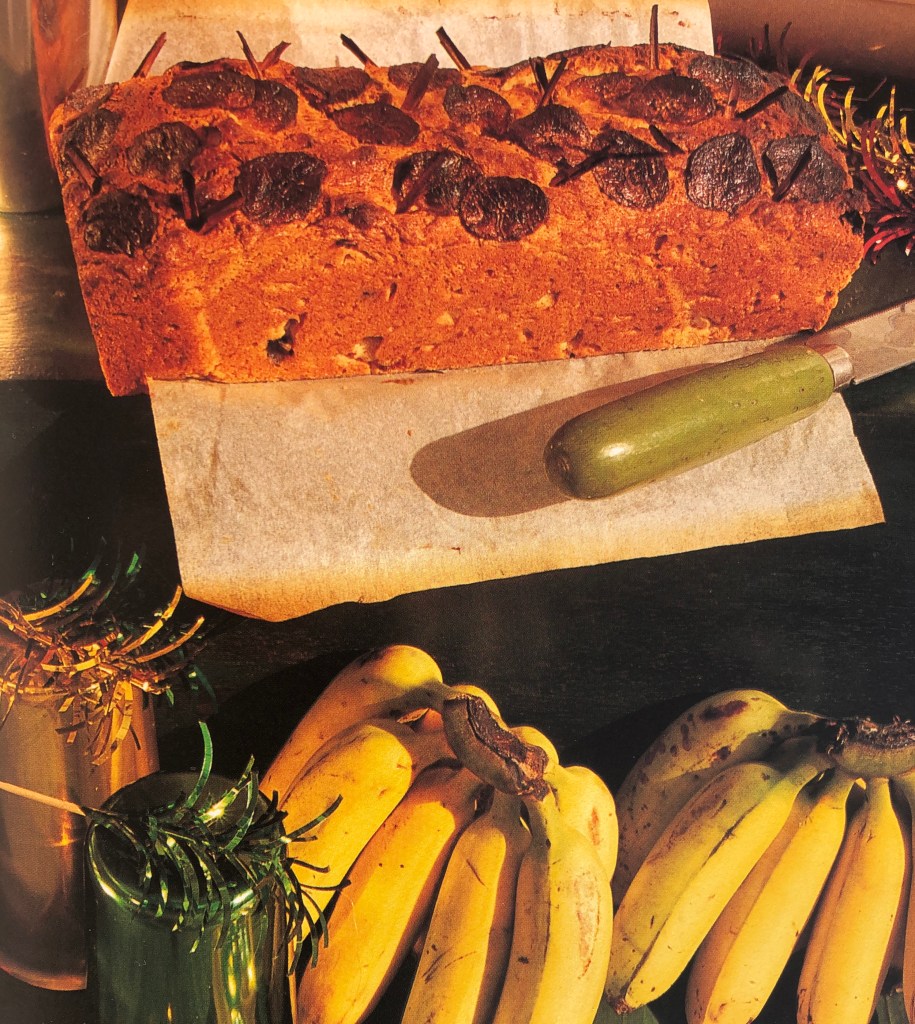
I sometimes add to this recipe a tablespoon or two of golden or dark rum at the point that I add the milk. It adds a little something special.
.
8 oz(250g) butter
8oz (250g) demerara sugar
3 very ripe medium bananas, peeled and mashed
1 medium egg, beaten
1 lb (500g) self-raising flour (or plain/all-purpose flour + 1 tablespoon baking powder)
½ teaspoon ground cinnamon
½ teaspoon freshly grated nutmeg, or ground nutmeg
½ teaspoon ground allspice berries (if you do not have this you can omit)
½ cup of milk
1 teaspoon vanilla extract (vanilla essence is a good substitute)
1 tablespoon of dark/golden rum (optional)
1 tablespoon seedless raisins
.
- Preheat the oven to 350°F/180°C/Gas 4.
2. Butter a 9 x 5 inch (22.5cm x 12.5cm) loaf pan.
3. Cream the butter and sugar together until light in colour.
4. Add the bananas and the egg and mix well.
5. Sift in the flour (and baking powder if using plain/all purpose flour), cinnamon, nutmeg and allspice and stir well into the mixture until combined.
6. Add the vanilla extract to the milk and stir. Gradually beat in the vanilla-milk liquid, and rum (if adding).
7. Stir in the raisins.
8. Pour the mixture into the prepared pan and bake in the centre of the oven until a skewer inserted in the middle comes out clean, about 45 mins-1 hour.
9. Allow to cool in the pan for 10 minutes, then turn the bread out onto a rack to cool completely.
Makes one 9 x 5-inch (22.5 x 12.5cm) loaf
 Pamela Lalbachan
I love this blog Pam – thank you – in particular for your skillful blending of food and history (and politics). And the banana bread recipe – mouth-watering; will have a go very soon.
LikeLike
Great one. And so easy to get the best out of isolife. Thanks for this.
LikeLike
Looks amazing! Can’t wait to try!
LikeLike